

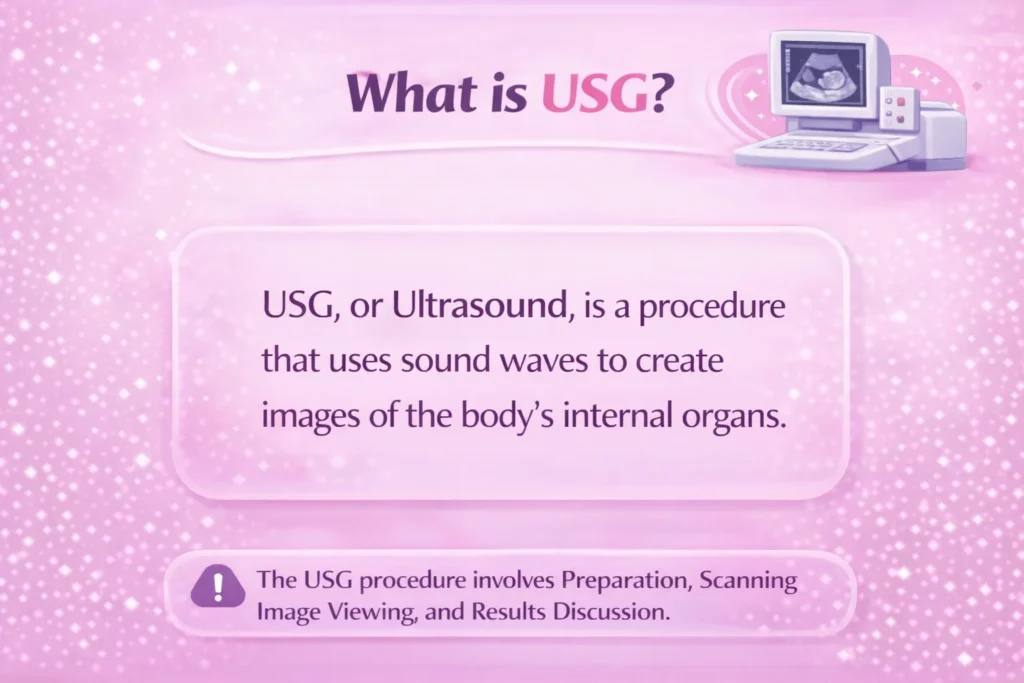
The USG full form is Ultrasonography. It is a safe, non-invasive imaging technique that uses high-frequency sound waves to create real-time images of the organs in your body. In pregnancy, USG plays a critical role in monitoring fetal growth, confirming heartbeats, and estimating the due date of the baby. The USG is widely used in obstetrics, gynaecology, and general medicine. Whether you hear it called a USG scan, an ultrasound, or a sonography test, they all mean the same imaging procedure.
You are sitting in the clinic waiting room, holding your prescription, and the doctor has just written USG scan on your slip. You nod, but somewhere in the back of your mind, you wonder, what exactly is this, and why do I need it?
Don’t worry, you are not alone. Many women encounter this term when they go through issues related to their reproductive health or during their pregnancy.
So let’s break down what is USG? And what is USG full form?
USG stands for ultrasonography or ultrasound scan. It is a non-invasive imaging technique that uses sound waves to create real-time images of your internal organs. Aastha Fertility Care’s specialist, Dr Namita Kotia (MBBS, MS – Obstetrics & Gynaecology) states that USG plays an important role in pregnancy by measuring the fetus, heartbeat or amniotic fluid levels, which helps the doctor to decide on necessary precautions or treatment to ensure a healthy baby.
According to the Ministry of Health and Family Welfare report, ultrasonography is now an established tool in the clinical management of pregnancy. It helps detect congenital malformations, confirm multiple pregnancies, and evaluate placental position, all without any radiation exposure.
Now to understand more about USG, USG full form, its types, procedure, reports, advantages & disadvantages, read this blog till the end.
USG Full Form in Pregnancy
This is a very common question that arises in the mind: What is the full form of USG?
Let’s understand in simple language: USG stands for Ultrasonography. In the context of pregnancy, it is the most common method of monitoring your baby’s first heartbeat, determining the gestational age, and ensuring that the placenta is healthy inside your womb.
What Is USG?
USG is a safe and painless way to get a clear picture of what is happening inside your body. It works by using high-frequency sound waves rather than radiation to create real-time images of your organs on a screen. During the scan, a small handheld device called a transducer sends out sound waves that bounce back as echoes, which the computer then turns into photos. It is an excellent tool for checking the health of your liver, gallbladder, and kidneys, and it is most commonly used in pregnancy to track a baby’s growth and development.
Life Changing Experiences with Aastha Fertility - From Doubt to Success
Types of USG
Depending on what your doctor needs to see, you may be recommended different types of USG scans, like abdominal USG, transvaginal USG, Doppler USG, etc.
Let’s understand each of them in detail:
1. Abdominal USG
This is the most common type of USG, where a gel is applied to your belly, and an ultrasound scanner is used to check if your organs, like the liver, kidney, or a growing baby inside your womb.
2. Transvaginal USG (TVS)
This USG is often suggested by your doctor to check the early pregnancy, or for other fertility checks, providing a clearer view of the uterus and ovaries.
3. Doppler USG
This measures the movement of blood through your blood vessels. This is crucial for checking the baby’s blood flow.

4. 3D and 4D Ultrasound
3D scans provide three-dimensional images and real-time moving video of your baby inside the womb, showing facial features and movement.
5. NT Scan (Nuchal Translucency Scan)
This scan is done between the 11th and 14th week of your pregnancy to measure the fluid-filled space at the back of your baby’s neck. It helps assess the risk of chromosomal conditions like Down syndrome.
Why Is USG Done?
A USG is not just about scanning your baby’s images. But, it can be done for many other reasons, such as:
- Pregnancy Monitoring: To check your baby’s position, growth, and heart rate.
- Diagnostic Purposes: To find the cause of pain, swelling, or infection in your internal organs.
- Guiding Procedures: To help your doctors perform biopsies or fluid drainage accurately.
- Fertility Tracking: To monitor follicle growth, which is essential for your conception or IVF cycles.
USG Procedure
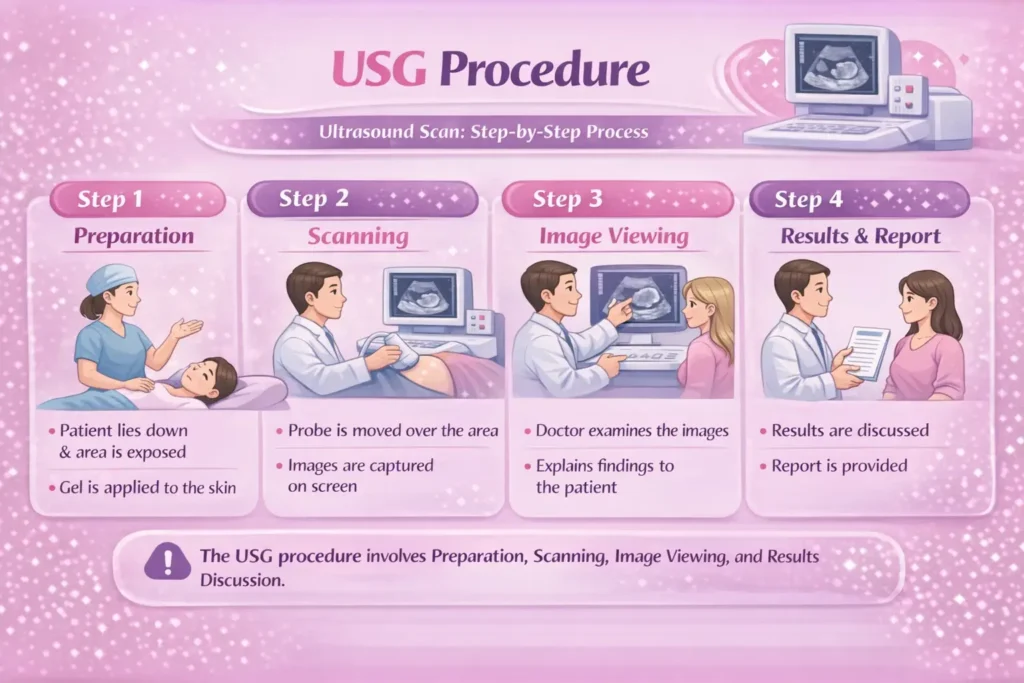
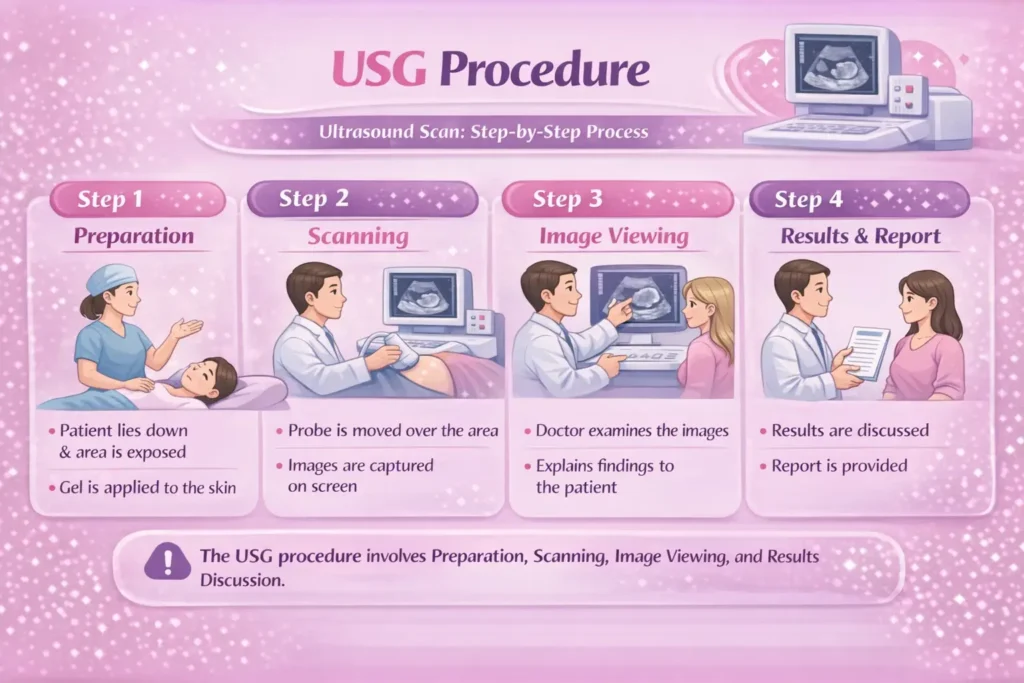
The USG procedure is simple and stress-free. Once you reach the hospital or the diagnostic centre, you will be asked to drink a lot of water until you feel the urge to pee immediately. But at this time, you have to hold your pee, and you will be asked to lie down on a stretcher or bed. Then, a clear, water-based gel will be applied to the area that has been examined. This gel glides well on your skin & helps the sound waves travel easily.
After applying the gel, the sonologist will move the transducer over your skin. You might feel a bit of pressure, but it is not painful. Most scans take between 15 to 20 minutes, and you can usually return to your normal activities immediately after USG.
Understanding USG Reports
Your doctors can ask you to get an ultrasound done for multiple reasons, but if we specifically talk about the USG scans for pregnancy, then the reports may include:
- GS (Gestational Sac): This gives the first sign of your pregnancy, which is usually visible after 5 weeks of conception.
- CRL (Crown-Rump Length): This is measured for understanding the date of the pregnancy and measuring the fetus from the top of the head to the bottom of the foot.
- BPD (Biparietal Diameter): This is the measurement of the fetus’s head, width, taken from one parietal bone to the other.
- FHR (Fetal Heart Rate): This is the measurement of the heart rate of the baby, which ranges between 110-160 beats per minute.
- EDD: This measurement shows the estimated date of the delivery.
USG Advantages & Disadvantages
Ultrasonography is a versatile tool to visualize and monitor the development of your baby, but it has both advantages and disadvantages that you should be aware of.
Let’s understand each of them in detail:
Advantages
- Safe with No Radiation: Ultrasonography is not like X-rays and CT scans, which can expose you to harmful radiation. It is safe for you and your baby during pregnancy, even if it is done multiple times.
- Real-Time Imaging: Ultrasound can capture the image of your organs inside the body, such as blood flowing in the vessels, the size of the uterus, etc.
- Painless Procedure: As these scans are performed on the skin with a water-like gel, which does not require needles or injections, it’s a pain-free procedure.
- Widely Available and Affordable: As compared to CT scans or MRIs, it is available in many portable formats for bedside use, and it is more affordable than other scans.
Disadvantages
- Image Quality Depends on Factors: Sometimes, due to excess gas, obesity, or if the position of the baby is awkward, it can limit the clarity of ultrasound images.
- Operator-Dependent: If the sonologist is not experienced, then it can lead to less accurate ultrasound images.
- Cannot Detect Everything: Ultrasonography may be beneficial to understand the estimated date of the delivery, but it cannot detect genetic disorders, metabolic conditions, or functional issues like deafness or blindness.
- Minor Discomfort: Ultrasounds are mostly painless, but due to the pressure from the transducer it may cause mild discomfort.
Conclusion
A USG scan is far more than a routine procedure; it is a powerful tool that gives you and your doctor clarity, confidence, and a closer look at what is happening inside your body.
Whether you are trying to conceive or are already pregnant, USG helps your doctor monitor your health and guide your treatment safely. But if you have any queries related to your pregnancy, or you and your partner are struggling to conceive, then you should speak with our fertility specialist at Aastha IVF Centre, Jaipur. Here, we can clear all your confusion about your parenthood journey.
At Aastha IVF Centre, every USG scan is performed with state-of-the-art equipment and interpreted by experienced fertility specialists who take the time to explain your findings clearly and compassionately. If you are ready to take the next step, our team is ready to guide you at every step. For more information, visit our website https://aasthafertility.com/ or book your consultation at 9829 069 228.
FAQ: USG full form
Does USG Produce Radiation?
No, USG uses high-frequency sound waves, not radiation. This makes it completely safe for repeated use, even during pregnancy.
Is USG Harmful During Pregnancy?
There is no evidence to suggest that a standard medical USG test (Ultrasonography) is harmful to the mother or the baby.
Is USG safe?
Yes, it is considered one of the safest diagnostic options because it doesn’t use chemicals or radiation, and it is the preferred method for monitoring sensitive conditions.
USG से बच्चे की ग्रोथ कैसे पता चलती है? (How is baby growth detected via USG?)
USG के दौरान डॉक्टर बच्चे के सिर की परिधि, पेट की चौड़ाई और पैर की हड्डी की लंबाई को मापते हैं। इन मापों से बच्चे के वजन और विकास का सही अंदाज़ा लगाया जाता है।
What is the difference between USG and sonography?
There is no difference! USG & sonography are simply other names for the same procedure. Both terms refer to the use of sound waves to create images of the body.





Leave a comment