

Finding out that you are expecting is exciting news and a load of tests. If your doctor has asked you to go for the double marker test, a million questions may be running through your mind. First and foremost, know that it’s a safe procedure where they extract a minuscule amount of blood and that most results are normal. Dr. Namita Kotia, IVF Specialist and Director of Aastha Fertility Care, Jaipur, often reassures her patients that screening tests are meant to inform and not scare them. In this post, we will discuss the double marker test, the time it’s taken, your reports, and how much it costs to get tested in India.
What Is a Double Marker Test?
The Double Marker Test, also known as the Dual Marker Test or the first-trimester maternal serum screening, is a blood test that analyzes two placental proteins to determine a baby’s likelihood of having certain chromosomal abnormalities. Double Marker Test is a screening procedure and not a diagnostic procedure so it only assesses risk and does not provide an answer.
This test is completely safe for your baby since it requires only a few drops of your child’s blood. It is like a weather report providing only an approximate risk level and your doctor will help you decide what to do next. This test cannot tell you the sex of the baby, which is illegal in India under the PCPNDT Act.
What Does the Double Marker Test Detect?
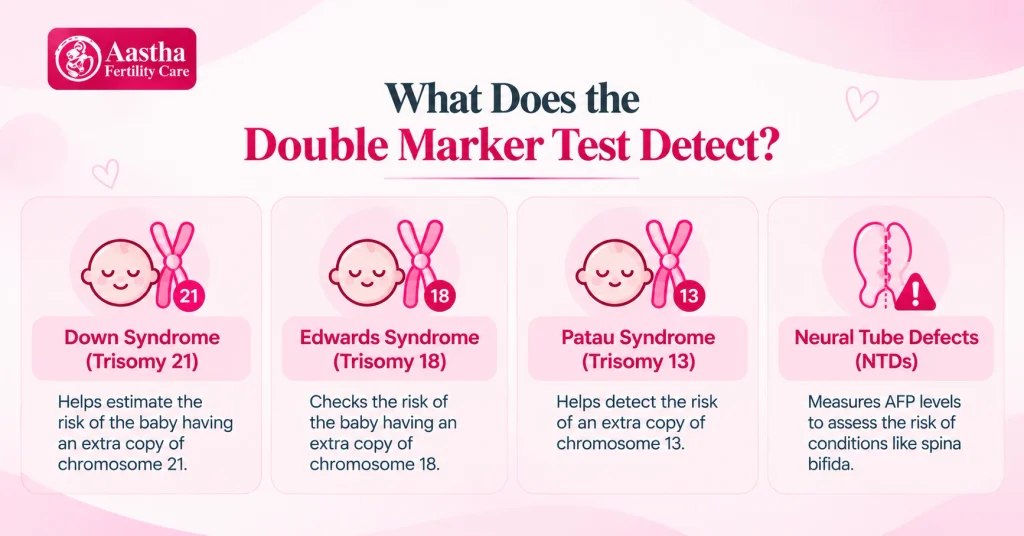
The test is designed to estimate the risk of three chromosomal abnormalities, namely,
- Trisomy 21 (Down syndrome),
- Trisomy 18 (Edwards syndrome)
- Trisomy 13 (Patau syndrome)
- Neural Tube Defects (NTDs)
The test is not comprehensive and does not guarantee the detection of all genetic or structural problems, nor does it diagnose them. The test’s accuracy increases when combined with an NT scan. All of these syndromes result from having an extra copy of a chromosome, making Down syndrome the most common among the three.
The Two Markers Explained
It’s called after the two substances which it measures in your blood.
Free Beta-hCG
This is a hormone produced by the placenta. Higher than normal levels are associated with increased risk of Downs syndrome, whilst very low levels might indicate Trisomy 18.
PAPP-A (Pregnancy-Associated Plasma Protein-A)
This is a protein which helps the placenta to grow. Lower than normal levels are associated with higher risks of Downs, Edwards and Patau Syndromes. It can also be an indicator of other complications; if you have lower than normal levels, it is likely that your growth will be monitored more closely.
Double Marker Test Weeks – When Should You Get It Done?
The double marker test is usually carried out between 11 weeks and 13 weeks 6 days of pregnancy, ideally just before or after the NT scan. Some labs offer the test up to 10 weeks. It is important that the dating is accurate so if possible you should have an early dating scan so that your lab can calculate your risk accurately.
The levels of the markers can change rapidly from week to week and the lab compares your results to the levels which would be expected at your gestational age. National guidance in the UK states that the combined test is suitable from 10 weeks gestation up to 14 weeks and one day. If you are due to take the test within this time frame but don’t get the chance, then your doctor may suggest a triple or quadruple screen test between 15 and 20 weeks or alternatively, NIPT.
Life Changing Experiences with Aastha Fertility - From Doubt to Success
How Is the Double Marker Test Done? (Procedure)
The double marker test is a simple blood test where blood is drawn out for testing. It is often paired with an NT scan on the same visit. You do not need to have an empty stomach for this test and the whole procedure is very quick and you can leave in a few hours. Results arrive within a few days. Here is what to expect, step by step:
- Confirm your dates. Share your last period date or an early scan report so the lab knows your exact week.
- Give a blood sample. A technician draws a small sample from a vein in your arm.
- Have your NT scan. A sonographer measures the clear fluid at the back of your baby’s neck, on the same day or close to it.
- Lab analysis. The lab measures both markers and combines them with your age, weight, dates and NT result.
- Receive your report. Results usually arrive within a few days.
How to Read a Double Marker Test Report
Your report should show your free beta-hCG and PAPP-A levels, usually as MoM (multiples of the median) with a risk ratio for each one. A ratio like 1:1000 is less risky than 1:100 so always check with your doctor as one number alone can’t show how much or little risk you have.
Risk Ratio – What Does It Mean?
The numbers show how many babies out of every 1000 similar cases are likely to be affected with those abnormalities. The bigger the second number is, the smaller the risk is. The lab will have a cut-off number (usually quoted as 1 in 150 for the UK and 1 in 250 for some labs in India) to show whether you were in the higher or lower risk group. Always go by the risk ratio quoted on your results.
Normal Range For Each Marker
As levels can vary depending on what stage you are at, most labs show values as a multiple of the median (MoM) and a figure between 0.5 and 2 for each is usually regarded as normal. Some labs use slightly different ranges. Having a higher than normal level of free beta-hCG with a low PAPP-A can be a sign of a higher risk of Downs Syndrome, but both levels being low could suggest Trisomy 18 or 13. Having a result outside the normal range does not mean you definitely have one of these problems and a result within the normal range does not rule it out.
What Can Affect My Results?
There are several things which could change the results so that they are not accurate:

- Incorrect gestational age
- Twin or multiple pregnancy
- Very high or very low body weight
- Having diabetes or an overactive thyroid
- Smoking and some medications
- Having become pregnant using IVF or ICSI or using donor eggs. If you have become pregnant in this way, make sure the lab knows so they can adjust your results if necessary. If you have used donor eggs, give them the age of the donor as this can affect the results.
Dual Marker Test Price in India
The two marker test cost in India normally falls between INR 1,700 to 3,700, depending on the lab, city and whether the NT scan is included. In Jaipur, recently posted prices are around INR 1,700 to 3,450. Prices can be volatile, so it’s a good idea to check with a few labs before getting one.
What Happens If the Double Marker Test Is High Risk?
A high risk result does not mean your baby has a condition, it means the chance is greater than the laboratory’s cut off and your doctor will recommend further tests. Many babies in this group are healthy. Just take a deep breath, you will have all the information you need and the best care.
Your doctor may recommend the following:
- Counselling to help understand your results and what the options are
- NIPT, a blood test which analyses the baby’s DNA in your blood for a more accurate screen
- Diagnostic tests such as CVS (from around 11 weeks) or amniocentesis (from around 15 weeks) which can confirm a diagnosis but do run a small risk of miscarriage.
Only a diagnostic test can confirm a condition. Whatever you decide, you are not alone.
Double Marker Test vs Triple Marker Test vs NIPT
The three tests screen for similar conditions at different times and with different accuracy. The double marker test is the earliest routine option, the triple marker test is a second-trimester alternative, and NIPT is the most accurate screening test but costs more. None of them is diagnostic.
| Test | When | What it checks |
| Double marker | 11 to 13 weeks 6 days | Free beta-hCG and PAPP-A, usually with NT scan |
| Triple marker | 15 to 20 weeks | AFP, hCG and uE3; also screens for neural tube defects |
| NIPT | From about 10 weeks | Baby’s DNA fragments in your blood |
Who Should Get the Double Marker Test?
Doctors can provide this procedure to all pregnant women, but patients with advanced maternal age, those who became pregnant due to in vitro fertilization, or those who already have pregnancies with chromosomal abnormalities are recommended to consider the test. The prenatal genetic screening is also indicated in cases of family history of genetic diseases and multiple miscarriages before. It is not mandatory, so patients need to discuss the periconceptional genetic testing option with their doctors.
The prenatal genetic screening is also recommended if there is a possibility of marriage between blood relatives. Couples who have experienced recurrent miscarriages can benefit from early screening tests as well. Moreover, women need to take care of their health in the early stages of pregnancy, for instance, take iron and folic acid supplements alongside the recommendation of the prenatal screening. It is possible to perform a pregnancy ultrasound in the first trimester by using transvaginal sonography.
Double Marker Test in Jaipur at Aastha Fertility Care
If you are looking for a double marker test in Jaipur, Aastha Fertility Care in Malviya Nagar can help you from booking to report. Dr. Namita Kotia will help you pick the right week for the testing, explain your report and plan the next steps with a special focus on cases involving IVF and ICSI pregnancies.
Our team will also help you plan the right time to get this test done keeping in mind your NT scan. We will make sure the lab has all the relevant details about conception dates and ensure you read the report with you line by line. We will also help you explore your options if your report reads high risk, but without pressuring you to make any decisions. You can visit us Monday to Saturday between 9:00 AM and 3:30 PM at 15 Usha Colony, Apex Circle, Calgary Road, Malviya Nagar, Jaipur, or call us at +91 141 436 4623 to book a double marker test in Jaipur.
Conclusion
The double marker test is a gentle way to begin your journey towards parenthood as it is a simple blood test that can give you an idea of any chromosomal deficiencies your child may be facing. A negative result is always a relief, and a positive result only means you need to take a closer look. If you need help understanding your report or picking a time for the test, consult our team.
FAQ
Expectant parents often have numerous questions regarding the double marker test – when to take it, how much it costs, what the results mean, etc. These frequently asked questions about the double marker test in pregnancy are explained briefly below, while more personal or complex matters require further consultation with a healthcare provider.
What is the double marker test?
The double marker test is a first trimester screening test that looks at two hormones: free beta-hCG and PAPP-A. Combined with an NT scan, this blood test calculates the risk of Down, Edwards and Patau syndromes.
When should I have a double marker test?
A double marker test is usually performed between 11 weeks and 13 weeks 6 days of pregnancy – near the time of the NT scan. Some centres also allow screening from 10 weeks.
Is the double marker test mandatory?
No. The test is optional but is typically recommended for women 35 years and older, those who become pregnant through IVF, and those with a family history of genetic disorders. Please consult your doctor for your particular case.
What is the normal range for the double marker test?
The normal range for the double marker test is different for each laboratory. In general, a value between 0.5 and 2.0 MoM is said to be normal for each hormone. Make sure to follow the reference range on your test report and consult your doctor.
What does a positive double marker test mean?
A positive or high-risk result does not confirm a chromosomal abnormality – it only means that the risk is higher than average. Your doctor may recommend genetic counselling or a diagnostic procedure such as CVS, amniocentesis, or NIPT to determine with greater accuracy whether the fetus has a chromosomal abnormality.
Can the double marker test detect Down syndrome?
The double marker test is a screening test, which means it cannot diagnose Down syndrome or any other chromosomal abnormality. However, UK-wide screening standards aim to detect more than 90% of cases of Down syndrome using the combined test (blood test + NT scan). A diagnostic test would be needed to confirm or rule out Down syndrome.
This blog is for informational purposes and does not replace a personal consultation. For advice based on your own reports and medical history, please consult your doctor or book a consultation with Aastha Fertility Care, Jaipur.





Leave a comment