
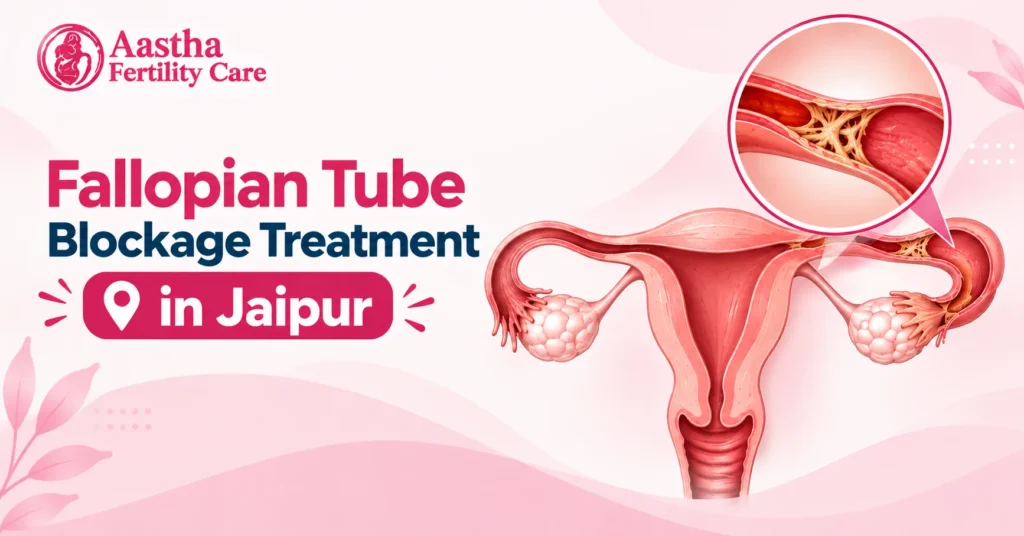
A blocked fallopian tube stops the egg and sperm from meeting, or stops an embryo from reaching the uterus. It often causes no symptoms and is found only when pregnancy does not happen. Fallopian tube blockage treatment in Jaipur usually follows one of three paths: monitoring or tubal flushing when only one tube is affected, laparoscopic surgery for selected blockages, and IVF, which bypasses the tubes completely. The right choice depends on where the blockage is, whether one or both tubes are affected, your age, and your ovarian reserve.
If you have been trying for a baby for a year or more, or an HSG report has just told you that a tube is “blocked”, it is normal to feel worried. The good news is that blocked tubes are one of the most treatable causes of infertility, because IVF can work around the problem entirely.
This blog focuses on treatment and what to do next. If you want the basics of how tubes work and why they block, read our fallopian tube blockage overview.
Dr. Namita Kotia (MBBS, MS – Obstetrics & Gynaecology), IVF Specialist and Director of Aastha Fertility Care, Jaipur, sees tubal factor infertility regularly in her practice.
“Many women hear the word ‘blocked’ and assume pregnancy is no longer possible. In reality, the question is not whether a tube is blocked, but where, how badly, and what your age and egg reserve allow. Once we know that, the path is usually clear.” – Dr. Namita Kotia, IVF Specialist & Director, Aastha Fertility Care, Jaipur
Can You Get Pregnant with Blocked Fallopian Tubes?
Yes can you get pregnant with a Blocked Fallopian Tube but it depends on the number of tubes affected.
- If one tube is blocked and the other is healthy: pregnancy is possible naturally, as the healthy tube can pick up an egg from either ovary. It may just take a little longer, especially if you have irregular ovulation or if you’re over 35.
- If both tubes are completely blocked: Natural conception is not possible. In some cases, surgery may be an option to repair the damage, but IVF is usually the best bet.
- Tubes that are partially blocked: You may still be able to get pregnant, but there’s an increased risk of ectopic pregnancy.
Tubal factor infertility is a recognized cause of infertility in women and unfortunately, many women aren’t aware of it until they go through the process of investigations. (Source: WHO, ASRM)
Types of Fallopian Tube Blockage
Where the blockage sits changes both the likely cause and the best treatment.
Life Changing Experiences with Aastha Fertility - From Doubt to Success
| Type | Where it is | Common causes | Usual approach |
|---|---|---|---|
| Proximal | Near the uterus | Infection, debris, spasm, past abortion or surgery | Tubal flushing or cannulation in selected cases; IVF if it persists |
| Mid-segment | Middle of the tube | Surgery, scarring, infection | Surgical repair rarely; IVF often |
| Distal | Near the ovary (the fimbrial end) | Pelvic infection, endometriosis, adhesions | Laparoscopy; hydrosalpinx needs special attention before IVF |
What Causes Fallopian Tubes to Block?
Fallopian tubes are usually blocked because of scarring from pelvic infections (including chlamydia, gonorrhoea and genital TB), endometriosis, previous pelvic surgery, or ectopic pregnancy. Rarely, tubes are blocked from birth. Most of the women show no symptoms so blockage is often found only during fertility tests.
- Pelvic inflammatory disease (PID): infections like chlamydia, gonorrhoea can lead to PID. This can block one or both fallopian tubes.
- Genital tuberculosis, the most common cause of blocked tubes in women in india that can damage the tubes and the uterine lining
- Endometriosis, this condition often causes adhesions and tubes to become twisted, narrow, or blocked. (see our endometriosis treatment in Jaipur guide)
- Previous pelvic or abdominal surgery: surgeries performed on the fallopian tubes including caesarean section, appendix or ovarian surgery, which can create adhesions
- Previous ectopic pregnancy: an ectopic pregnancy is when pregnancy develops outside the uterus, usually in the fallopian tubes. This can block one of the tubes.
- Fibroids: fibroids pressing on the tubes can lead to obstruction.
- Congenital differences: rare birth defects can lead to blocked tubes.
Symptoms: Why Most Women Have None
Most women with blocked fallopian tubes don’t experience any symptoms. In fact, difficulty getting pregnant often is the reason they seek medical attention. Some women with blocked fallopian tubes experience these common symptoms:
- One-sided pelvic or abdominal pain
- Painful menstruation (periods) or painful sexual intercourse
- Unusual vaginal discharge (if the blockage is caused by an infection)
- A dull ache in the pelvis or lower abdomen, or unusual vaginal discharge may occur when a fallopian tube is distended with fluid (hydrosalpinx)
Symptoms can’t be used to diagnose blocked fallopian tubes, however a definitive diagnosis requires tests.
How Fallopian Tube Blockage Is Diagnosed at Aastha Fertility Care
Diagnosis of a blocked fallopian tube in jaipur begins with taking account of your fertility treatment history, the duration of your attempts to get pregnant, any infections, surgeries, and previous pregnancies. To diagnose a blocked fallopian tube, following imaging and tests are performed:
- Transvaginal sonography (TVS): This is a vaginal ultrasound that examines the uterus and ovaries for the presence of a distended tube (hydrosalpinx)
- HSG (hysterosalpingography): this is a radiological method that involves injecting a contrast agent into the uterine cavity while X-ray imaging visualizes the flow through the fallopian tubes
- HyCoSy: this is an alternative to HSG, which is performed under ultrasound guidance and also involves the introduction of a contrast agent.
- Laparoscopy with dye test: this is a minimally invasive procedure that visualizes the fallopian tubes directly and is the most accurate of all available methods: it also allows for the treatment of some of the diagnosed conditions
Sometimes, an HSG may show a “blocked” tube, which in reality is only a spasmed tube: in such cases, a repeat procedure or a laparoscopy may be required before any treatment, such as IVF, can be planned. It is important not to make any definitive conclusions based on one test, especially if it is positive. Find out more about what tests are required for IVF treatment.

Fallopian Tube Blockage Treatment Options in Jaipur
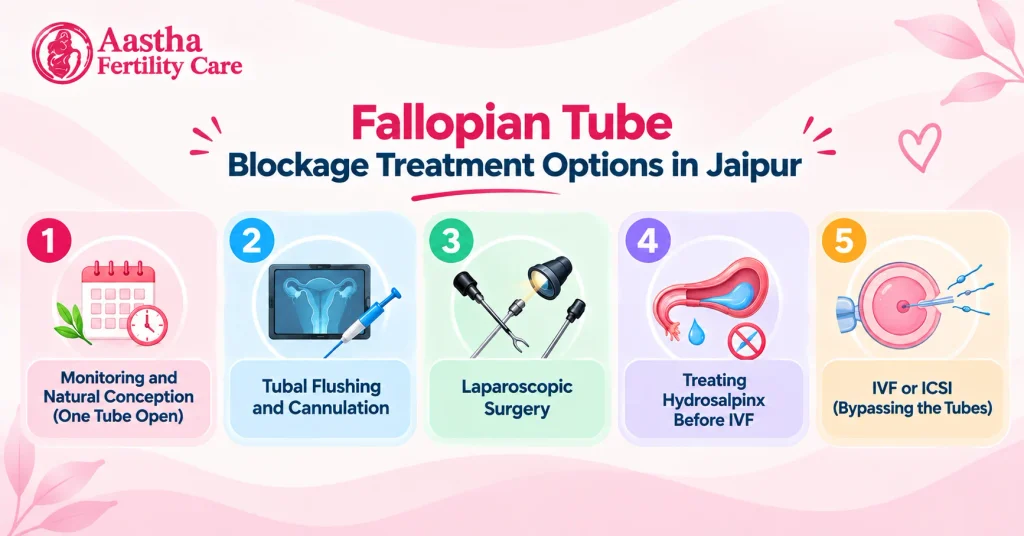
1. Monitoring and Natural Conception (One Tube Open)
If you have one tube affected, the other is healthy, you are under 35 and ovulate normally, your doctor may suggest trying to get pregnant naturally for a certain amount of time while monitoring your ovulation. Your partner’s semen count should also be checked.
2. Tubal Flushing and Cannulation
In certain instances where a proximal blockage is present, it is sometimes possible to clear the fallopian tube, either by flushing it during an HSG, or by inserting a very thin catheter into the affected tube. This is only applicable to certain types of proximal obstruction (such as those due to debris) and not for tubes that are scarred.
3. Laparoscopic Surgery
Laparoscopic surgery can be used to free tubes that are adhered, or to treat endometriosis, and in some cases, to unblock the end of a tube. Tubal surgery is best applied to relatively minor obstructions, where the lining of the tube is normal, and in younger women. It is not possible to repair a tube that is severely scarred, and antibiotic treatment will not work on a blocked tube. Surgery on the tubes is not an option if there is extensive adhesion, or if the tubes have been damaged beyond repair.
4. Treating Hydrosalpinx Before IVF
A blocked tube that has become distended with fluid can reduce the chance of a successful pregnancy, even with IVF. Your doctor may recommend that you have key-hole surgery (laparoscopy) to remove or tie off the affected tube before proceeding with embryo transfer. This can make a big difference to the outcome for IVF.
5. IVF or ICSI (Bypassing the Tubes)
An IVF treatment can sometimes bypass blocked fallopian tubes by removing the eggs directly from the ovaries and fertilising them in a dish before returning them to the uterus. IVF treatment is usually recommended if both tubes are blocked, surgery is likely to fail, you are over 35, or if you have tried other treatment without success. A procedure called ICSI may also be used with IVF if there is a proven male factor subfertility. Note that IUI is not a good option when both tubes are blocked, since it requires that at least one of them is open and functioning.
If an earlier cycle did not work, an IVF failure consultation can help find out why.
Which Treatment Is Right for You?
There is no best treatment for a blocked fallopian tubes. Before choosing the right treatment for you, doctor typically takes into account four parameters
- Which tubes are affected: one tube or both, partial or complete
- Where the blockage is: near the uterus, mid-tube, or near the ovary
- Your age and ovarian reserve: time matters more as AMH falls. If your AMH is also low, see our guide on low AMH treatment in Jaipur
- Other factors: endometriosis, fibroids, past TB, or male-factor infertility
As a rule of thumb, young women with an apparently normal tube and a blocked tube may be considered for a natural cycle, while those with a focal block that can be surgically repaired may be considered for surgical restoration of the fallopian tubes. However, when both tubes are blocked, or there is hydrosalphinxs, or advanced maternal age (more than 35 years) or diminished ovarian reserve, it is often better to proceed to IVF as soon as possible. It is only after going through these parameters that the doctor will chalk out a personalized treatment plan for you.
Ectopic Pregnancy: Know the Warning Signs
Since ectopic pregnancy is common in women with damaged or blocked fallopian tubes, it is advisable to get immediate medical attention if you have a positive pregnancy test along with any of the following:
- Sharp or one-sided lower abdominal pain
- Vaginal bleeding or spotting
- Dizziness, fainting, or shoulder-tip pain
An early scan is advised in such cases to rule out ectopic pregnancy especially if there is history of fallopian tube disease.
Common Myths About Unblocking Tubes
- “Herbal remedy, castor oil pack or steam therapy can unblock scarred tubes.” There is no evidence that any of these measures can effectively clear tubes blocked by adhesions. Time lost pursuing these measures can be detrimental.
- “Taking antibiotics will clear blocked tubes.” Antibiotics are effective in treating infection of the tubes (adnexitis) but have no effect on adhesions.
- “If the tubes are blocked, as shown by an HSG, the only option left is IVF.” There may be other options. Sometimes normal tubes or tubes thought to be blocked are found to be temporarily spastic and/or blocked by mucus or cellular debris and can often be cleared with proper treatment.
- “If one tube is blocked, I can’t get pregnant.” Many women who have one normal tube do get pregnant.
What to Expect at Your First Consultation
- Review of your reports: HSG, ultrasound, hormone tests, previous surgeries
- A fresh ultrasound if needed, and a check of your ovarian reserve
- A conversation about your timeline: your age, how long you have been trying, and your goals
- A step-by-step plan: the most conservative option that is likely to work for you, with IVF discussed honestly if it is the better route
Why Choose Aastha Fertility Care for Fallopian Tube Blockage Treatment in Jaipur
- 15+ years of experience: Dr. Namita Kotia has been treating tubal factor infertility for 15+ years
- Honest advice on surgery versus IVF: you are not pressured toward either; a strategy is developed based on your tests
- Diagnostics are co-ordinated: ultrasound, hormone and semen tests, and referrals for HSG or laparoscopy are co-ordinated by a single team at Malviya Nagar [verify]
- In-house embryology: Dr. Ramdoss Srinivasan, Chief Embryologist is in charge of eggs and embryos at the lab
- Clear expectations: you are told your realistic chances and time frame at the very first meeting
- Care close to home: state-of-the-art tubal-factor treatments without having to go to Delhi or Mumbai
Conclusion
A blocked fallopian tube can be disheartening, but it’s usually not a deal-breaker. Whether it’s a minor blockage that can be cleared up with a minor operation or something more serious, the best course of action will depend on where the blockage is and whether both your fallopian tubes are affected. However, there are options beyond surgery, including IVF treatment, which bypasses the tubes altogether. The most important thing is to get the right tests done and make the right decision.
If you’ve been diagnosed with a blocked fallopian tube or are having difficulty getting pregnant for any reason, the team at Aastha Fertility Care can go through your reports with you and work with you to decide what the best course of action will be.
FAQs: Fallopian Tube Blockage Treatment in Jaipur
What is the best treatment for blocked fallopian tubes in Jaipur?
The best treatment depends on several factors such as whether it is one or both tubes that are blocked, the location of the blockage, and your age and ovarian reserve. The treatment options available are natural cycle monitoring, flushing of tubes, laparoscopic surgery, and IVF.
Can blocked fallopian tubes open themselves?
In some cases, when the problem is adhesions or spasm, the tubes may open up and down on their own accord; however, if the tubes are blocked due to scarring or infection, they must be surgically reconnected. It is best to go through a series of diagnostic tests to determine what kind of blockage you are dealing with.
Can I get pregnant with one blocked fallopian tube?
It is possible to get pregnant with just one open fallopian tube as long as you are ovulating normally. You may want to consider seeing a fertility specialist if you are over 35 years old because having an egg is more challenging as you age.
Is IVF the only option if both my tubes are blocked?
IVF is not the only option if both your tubes are blocked but it does have higher success rates than surgery, especially for older patients or those with significant damage to their reproductive organs. Surgery can be considered in cases where there is limited blockage which can easily be removed by a specialist.
Is the HSG test painful?
Most women do not find the procedure particularly painful; however, you may experience some cramping similar to menstrual pain for a brief moment during the test. Taking a pain reliever before the test as advised by your doctor should ease any discomfort.
Does surgery for blocked tubes have a success rate?
The success rate varies depending on several variables such as type/blockage location and your overall health condition amongst other things mentioned above but generally good results can be expected after consulting with our specialists who will advise further based on individual circumstances
How much does it cost to treat blocked fallopian tubes in Jaipur?
There is no singular price listed because costs vary depending on the type of tests required to diagnose your condition plus additional treatments like surgery or IVF if needed. However,aastha fertility care offers competitive pricing packages that you will discuss during your initial consultation prior to beginning any form treatment plan.
This blog is for informational purposes and does not replace a personal consultation. For a diagnosis and treatment plan based on your own reports and history, please book a consultation with Aastha Fertility Care, Jaipur.




Leave a comment