
Neither fresh or frozen embryo transfer is better for everybody. In the case of fresh embryo transfer, the embryo is implanted into the uterus immediately after the egg retrieval, while in the frozen embryo transfer, the embryo is frozen in the previous cycle and then transferred in the next cycle. The live birth rate is the same, but FET reduces the risk of overstimulation (OHSS). Thus, your doctor decides according to your health condition.
Key Takeaways
- A Cochrane review of 8 trials involving 4,712 women found little or no difference in live birth rates between fresh-first and freeze-all IVF approaches.
- OHSS risk was around 3% with conventional IVF versus 1% with freeze-all.
- With modern vitrification, over 90% of frozen embryos may survive thawing in well-equipped labs.
When you have completed the egg retrieval and embryo development process, you may be shocked when the doctor asks whether the embryo needs to be transferred at once or be frozen until another cycle. It is natural to think that you lose your time and the embryo can be damaged due to the freezing procedure.
Aastha Fertility Care की Director और IVF Specialist Dr. Namita Kotia (MBBS, MS – Obstetrics & Gynaecology) will help you to understand fresh or frozen embryo transfer in clear terms.
What Is a Fresh Embryo Transfer?
The procedure of the fresh embryo transfer means that the embryo is implanted into your uterus 3 to 5 days after egg retrieval, in the same IVF cycle, without being frozen. Your eggs are retrieved, fertilized with the sperm in the laboratory, and then the best embryo is transferred.
The benefits of fresh embryo transfer are as follows:
- Less complicated process as there is no need for freezing and thawing.
- Early pregnancy test since the transfer takes place in the same cycle.
- Many people find it easier to complete the process all at once.
The drawback is that your body just had potent fertility shots. Hormone levels could stay high after this procedure and the uterine lining may not be optimal for the embryo.
What Is a Frozen Embryo Transfer (FET)?
Frozen embryo transfer (FET) is the procedure where embryos frozen after egg retrieval are thawed and transferred in a different, scheduled cycle. The embryos are frozen through a fast technique known as vitrification and kept in the laboratory until your body is prepared.
During this period, hormone levels stabilize after stimulation shots. Once the uterine lining is ready, the embryo is thawed and transferred to the uterus. Embryo transfer is the last step in IVF treatment that starts with ovarian stimulation and egg retrieval.
Fresh vs Frozen Embryo Transfer – Key Differences
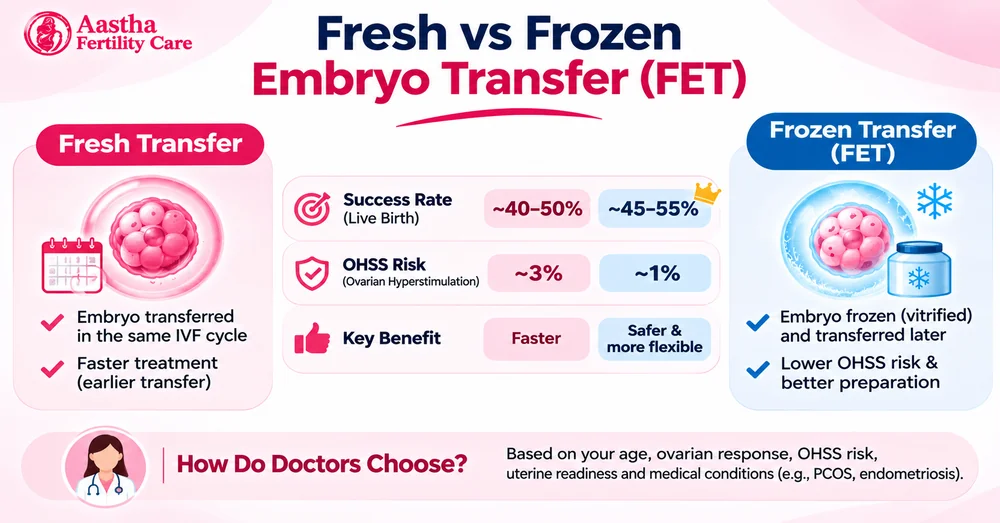
The primary distinction between fresh and frozen embryo transfer is the time of their occurrence: a fresh embryo transfer is carried out in the same cycle as egg retrieval, while an FET is carried out in a subsequent cycle when your body is no longer under the influence of stimulating medications.
| Factor | Fresh Transfer | Frozen Transfer (FET) |
|---|---|---|
| Timing | 3–5 days after retrieval | Later cycle, often 1–2 months after |
| Hormone levels | High from injections | Closer to natural, well controlled |
| Uterine lining | Prepared in the same cycle | Prepared separately with medicines |
| OHSS risk | Higher in some women | Lower, as the transfer is delayed |
| Extra steps | None | Freezing, thawing, lining preparation |
| Genetic testing (PGT) | Hard to wait for results | Time to receive results |
| Cost | One cycle | Extra freezing, storage and transfer charges |
| Best for | Good response, no risk factors | OHSS risk, PCOS, high hormones, testing |
Fresh & Frozen Embryo Transfer Success Rate
Generally, the probability of delivery is comparable for both techniques for the majority of women as success depends more on such factors as age, embryo quality, and receptivity of the womb than the technique itself.
Life Changing Experiences with Aastha Fertility - From Doubt to Success
The Cochrane Review, which is considered one of the highest-level evidence types in the medical community, found little or no significant difference in the cumulative rates of live births between the two techniques under study. According to that, in case 58 out of 100 women gave birth to a child in the conventional technique, the estimate in freeze-all was between 56 and 65 out of 100.
Some people argue that the probability of success is higher due to such reasons as FET providing a more comfortable environment for the embryo. Indeed, once the effects of stimulation hormones decrease, the uterine lining becomes more receptive.
However, the same review found that freezing the embryos might slightly increase the risk of developing hypertension during pregnancy as well as a higher weight of the baby. Thus, the choice between FET vs. fresh embryo transfer must be done by your healthcare provider based on the personal case analysis.
When Doctors Recommend Fresh Embryo Transfer
A doctor will advise you to have a fresh embryo transfer if you are a good responder to fertility medications, you have normal hormone levels, there is no risk of OHSS, and there is no need to wait for any results of the tests.
A fresh embryo transfer may be suitable for you if:

- You are young and your ovaries react normally to injections.
- You have normal progesterone levels at the moment of triggering.
- Your uterine lining is healthy on ultrasound.
- You are not planning genetic testing of your embryos.
When Doctors Recommend Frozen Embryo Transfer (FET)
There are certain cases when doctors suggest performing frozen embryo transfer as an alternative to fresh transfer that can be potentially unsafe or ineffective. Such cases include the possibility of OHSS, thin endometrium, high levels of progesterone, PCOS, or embryo genetic screening.
The key advantages of frozen embryo transfer are given below. The frozen embryo transfer can benefit you in the following ways:
- Reduces the risk of OHSS that is safer for women with a high number of follicles.
- Permits the preparation of the uterus at the proper time without the influence of stimulating injections.
- Gives time to get PGT results before selecting the embryo.
- Allows storing additional embryos to conceive the second child in the future without repeating the egg retrieval procedure.
- Gives time to prepare your body for pregnancy.
Thus, the choice between FET vs fresh transfer is not the question of which method is more powerful, but which one is safer and better timed for your body.
What Is the FET Process Like? (Step-by-Step)
A frozen embryo transfer entails preparing your uterus with drugs, thawing out the embryo, then transferring it quickly. The procedure generally takes 3 to 4 weeks from the start of preparations up until the point when the embryo is transferred.
- Frozen embryo transfer will follow these general steps:
- Planning visit: Your doctor examines your embryos and menstrual cycle.
- Linings Preparation: You take medications or patches, and occasionally injections, to allow the thickening of the uterine lining.
- Ultrasound Scan: Your doctor ensures that the lining has been prepared to the correct thickness.
- Progesterone Preparations: You begin taking progesterone to help prepare your uterus for an embryo.
- Thawing: The embryologist ensures that the embryo is warmed just a few hours before the transfer.
- Transfer: An embryo is inserted using a tiny catheter and into your uterus without pain.
- Pregnancy Test: A blood test is carried out after 10 to 14 days.
Does Freezing Damage Embryos?
Modern days vitrification is highly safe, and almost all high-quality embryos remain unharmed after thawing, so embryo cryopreservation won’t influence baby’s health if performed in an experienced laboratory.
This is one of the most common patient worries. Slow freezing technology can cause ice crystal formation inside the embryo; however, vitrification freezes so fast that no ice crystals form. In a published study, survival rate after warming was 96.9% using vitrification technique versus 82.8% using slow freezing.
Survival rate still depends on embryo quality and on the skills of the lab staff – that is why embryology lab is of the same importance as the doctor for embryo freezing decision.
Fresh vs Frozen Transfer – Which Is Right for You?
Selection will depend on the individual circumstances, because there isn’t one solution that suits all women.
Fertility doctor will take into consideration the following before deciding for either FET or fresh embryo transfer:
- Patient’s age and ovarian response to the drugs used
- Hormonal blood level on the day of trigger shot
- Embryos’ number and quality
- Risk of OHSS and patient’s IVF experience
- Intention to perform genetic testing of the embryos
Conclusion
Either fresh or frozen embryo transfer can result in a successful pregnancy; however, you should opt for a method depending on your body condition at a certain stage of treatment. Remember that in case you are afraid of waiting for a frozen transfer, then such waiting time is needed to prepare your uterus.
In case you are confused regarding the choice of an option, schedule a consultation with an IVF specialist who will analyze your embryos and results of tests.
FAQ
Are frozen embryos transfers more successful than fresh?
No, they are not. Although the rates of birth are the same in general, sometimes, the frozen transfer can prove to be a good choice for women with high hormone levels or at the risk of OHSS.
When will my frozen embryo transfer be performed?
Frozen embryo transfer is normally performed in the next menstrual cycle, usually 1 or 2 months after egg retrieval. Your doctor will tell you when it is a proper time for you.
What is the risk of embryo injury due to freezing?
In terms of new methods of freezing such a risk is very low, however, in rare cases some embryos can not survive freezing.
Is the FET expensive compared to fresh transfer?
While a FET would be cheaper as compared to the entire course of IVF treatment in one shot, but the freezing, storage and medication would increase the cost. It is better to take an estimate from your fertility clinic.
Can I decide whether I want to go with fresh or frozen transfer?
Yes, you can discuss this with your doctor and he can suggest you the safer alternative according to your health condition.
Does Aastha Fertility Care, Jaipur provide both fresh and frozen embryo transfers?
Yes, Aastha Fertility Care in Jaipur provides both fresh embryo transfers and frozen embryo transfers depending upon each patient’s hormone levels, embryos quality and past health condition.




Leave a comment