
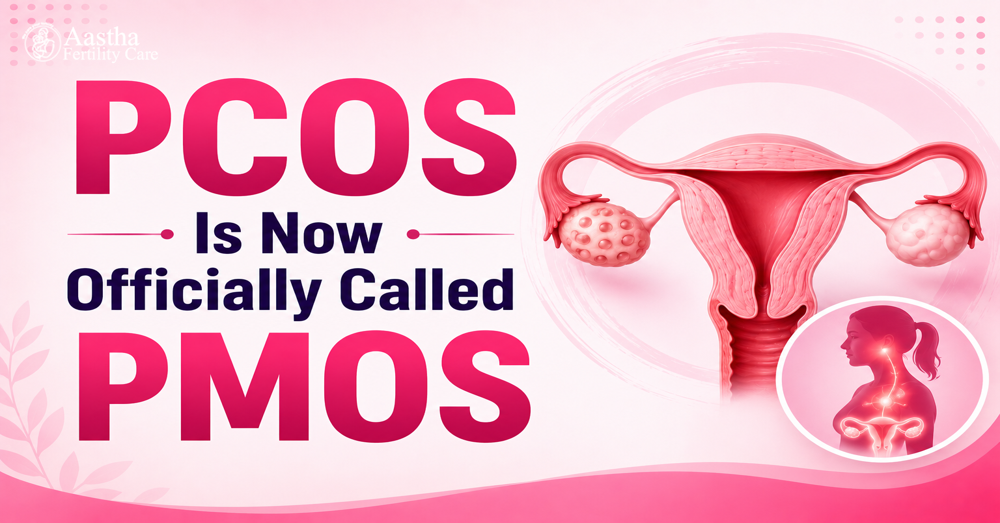
PCOS (Polycystic Ovary Syndrome) has officially been renamed PMOS (Polyendocrine Metabolic Ovarian Syndrome) in 2026 following an international medical consensus published by The Lancet. The change was introduced because the previous name focused heavily on ovarian cysts, even though many patients do not have actual cysts and experience broader hormonal and metabolic problems. The new name better reflects the condition as a whole-body disorder involving multiple hormone systems, metabolism, insulin resistance, reproductive health, and ovarian function. Although the name has changed, the condition itself remains the same. Existing PCOS diagnoses are still valid, and patients do not need new tests or immediate changes in treatment. PMOS may include symptoms such as irregular periods, acne, weight gain, excessive hair growth, fatigue, mood changes, insulin resistance, and fertility challenges. The updated terminology aims to improve diagnosis, reduce stigma, and encourage a more comprehensive treatment approach that focuses on overall hormonal and metabolic health.
You have probably spent years saying “I have PCOS”. Maybe you were diagnosed recently, or maybe you have been managing it for a long time. But now the diagnosis is changed, and the PCOS has a new name, which is PMOS.
In May 2026, a landmark global consensus published in The Lancet officially renamed the condition you have known as PCOS (Polycystic Ovary Syndrome) to PMOS (Polyendocrine Metabolic Ovarian Syndrome).
To explain this further, Dr. Namita Kotia (MBBS, MS – Obstetrics & Gynaecology), IVF Specialist and Director of Aastha Fertility Care, Jaipur, states that this updated framing helps women receive comprehensive, cross-disciplinary care that addresses root causes like insulin resistance, hormone imbalances, and long-term metabolic health alongside reproductive goals. While their daily treatments, lifestyle management, and diagnostic criteria remain identical, the transition to the PCOS new name ensures clearer communication, reduced social stigma, and better targeted care.
If you have ever been told your cysts don’t look that bad and you don’t really fit the PCOS picture, or if you want to know the latest update about the PMOS, then this blog is for you. Here, we will break down what PCOS renamed PMOS 2026 actually means, why was PCOS renamed, why doctors finally made this call, and most importantly, what it means for you going forward.
What Was Wrong With the Name “PCOS”?
For decades, the term Polycystic Ovary Syndrome did a massive disservice to women. The primary issue with the old name was that it was highly inaccurate and misleading. It focused mostly on the ovaries, implying that the root of your health struggles was a collection of ovarian cysts. But in reality, women with this condition do not have abnormal, fluid-filled cysts. What appears on an ultrasound are actually small, undeveloped fluid sacs called arrested follicles.
During a menstrual cycle, your ovaries produce several follicles, and one matures to release a healthy egg. When your hormones are out of balance, this maturation process gets interrupted, and the follicles stop midway.
By labelling these stalled follicles as cysts, the old name created unnecessary fear. Furthermore, it completely ignored the deep hormonal, metabolic, and emotional battles you face every single day, such as stubborn weight gain, fatigue, and intense mood swings. The medical community realized that the old name was simply too narrow for a condition that affects your entire body. So, they decided to rename it.
What Does PMOS Mean?
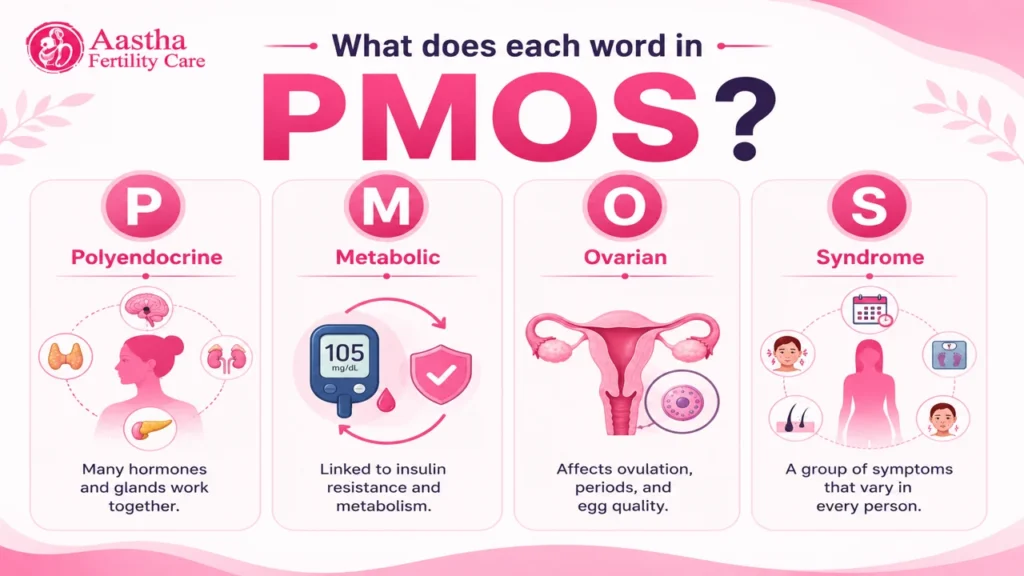
PMOS stands for Polyendocrine Metabolic Ovarian Syndrome. This name was chosen after a 14-year-long global consultation process that involved over 14000 patients and healthcare professionals across the globe, including prominent reproductive societies in India.
Life Changing Experiences with Aastha Fertility - From Doubt to Success
What does each word in PMOS mean?
- Polyendocrine: Poly means many, and endocrine refers to your hormone system. This acknowledges that your symptoms are not coming from just one organ. It is a complex interplay involving your ovaries, your adrenal glands, your pituitary gland, and your pancreas.
- Metabolic: This is the most crucial addition. It highlights the fundamental role that insulin resistance and metabolism play in the condition. It explains why managing blood sugar, energy levels, and cardiovascular health is so important.
- Ovarian: Your ovaries are still a key part of the story, as the hormonal imbalance directly impacts ovulation, egg quality, and menstrual regularity.
- Syndrome: A collection of signs and symptoms that occur together, showing up uniquely in every individual’s body.
PCOS vs. PMOS — Same Condition, Better Understanding
This table will help you see clearly what changed and why it matters:
| Feature | Old Name: PCOS | New Name: PMOS |
| Full Term | Polycystic Ovary Syndrome | Polyendocrine Metabolic Ovarian Syndrome |
| Core Focus | Ovarian anatomy and the structural appearance of cysts. | Systemic hormone health, cellular metabolism, and ovarian function. |
| Clinical Message | Implies an isolated gynecological or reproductive problem. | It states it is a multi-system, life-long metabolic and endocrine condition. |
| Patient Impact | Caused fear of physical cysts and localized ovarian disease. | Validates whole-body struggles like insulin resistance and fatigue. |
Why Is PMOS a Better Name?
The PCOS new name PMOS is better for several important reasons. Let’s understand why:
- It reflects the full reality of the condition: This is not just a problem with your ovaries. It is a complex hormonal disorder that affects your insulin levels, your weight, your skin, your heart health, your mental health, and your reproductive health. The word polyendocrine covers the fact that multiple hormone systems are involved, not just the hormones that control ovulation.
- It removes the misleading focus on cysts: Millions of women have been confused and misdiagnosed because they or their doctors took the word cysts too literally. With PMOS, there is no such confusion built into the name itself.
- It opens the door to better, more complete care: When the name says metabolic, doctors are more likely to check your insulin resistance, blood sugar, cholesterol, and cardiovascular risk. That is an early intervention that can genuinely protect your long-term health.
- It reduces stigma: A clearer, medically accurate name means less room for dismissal, misinformation, or misunderstanding, both from healthcare providers and from society.
- It creates research momentum: With a more accurate name, future research can focus on PMOS subtypes and more personalised treatments, which will benefit every woman living with this condition.
How the Name Change Happened
This name change did not happen overnight. It was the result of a long, careful process that took 14 years and involved one of the most detailed disease-renaming efforts in women’s health.
The discussion began in 2015, when international medical experts agreed that the old name, PCOS, did not fully explain the condition. After that, years of surveys, workshops, and global consultations were carried out with the support of 56 leading medical, academic, patient, and clinical organisations.

By May 2026, an international team led by endocrinologist Professor Helena Teede from Monash University had gathered insights from more than 14,000 people. This included patients, doctors, researchers, advocacy groups, and charities from different countries. The aim was simple: to choose a name that better reflects what the condition actually is and how it affects people.
After testing three final name options with participants from across the world, PMOS was selected as the preferred name.
The findings were published in The Lancet on 12 May 2026 and presented on the same day at the European Congress of Endocrinology. However, the change will not be immediate. To give hospitals, clinics, health records, and medical organisations enough time to adjust, both names, PCOS and PMOS, will be used together for three years. And the name PMOS is expected to become fully adopted by 2028.
PMOS Symptoms
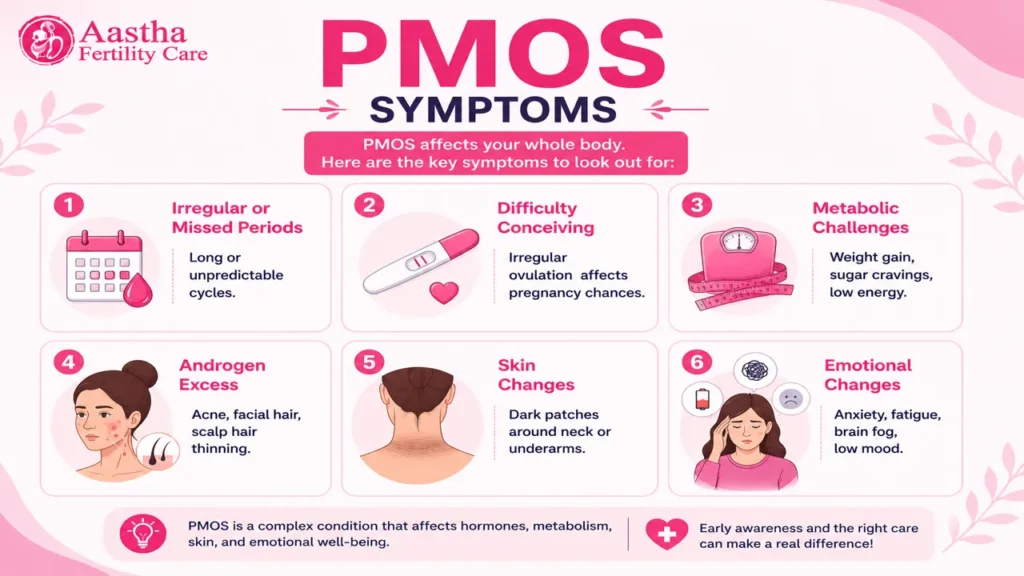
Because PMOS is now understood as a full-body condition, its symptoms go beyond what you might have been told before. So, let’s understand what PMOS involves:
- Irregular or Missed Periods: Your cycles may be consistently long (over 35–40 days) or completely unpredictable due to irregular ovulation.
- Difficulty Conceiving: Because eggs are not being matured and released regularly, it can take longer to achieve a successful pregnancy.
- Metabolic Challenges: Unexplained weight gain, trouble managing your weight despite consistent efforts, intense sugar cravings, and sudden energy crashes.
- Androgen Excess: Signs of elevated male hormones, including stubborn cystic acne along the jawline, excess facial or body hair growth (hirsutism), or thinning hair on your scalp.
- Skin Changes: Patches of darkened, velvety skin (acanthosis nigricans) around the neck, armpits, or groin, which are direct signs of high insulin levels.
- Emotional Changes: High levels of anxiety, persistent low mood, brain fog, and chronic fatigue.
What This Means for Patients
If you already have a PCOS diagnosis, this is what you need to know clearly and calmly:
- Your condition has not changed; your diagnosis is still valid: You do not need to start your treatment from scratch. PMOS is the same condition, just with a name that finally does justice to what you are actually experiencing.
- You do not automatically need a new diagnosis: Doctors, hospitals, and insurance providers are in the process of updating their systems to reflect the new name. This will happen gradually. So, your current documentation and medical records remain valid.
- Your treatment plan does not necessarily change: If what you are doing is working, continue it. And if you feel your treatment has been too narrow, this is a good time to speak with your doctor about a more holistic approach.
- You may now find it easier to be taken seriously: The PCOS new name PMOS carries more medical weight as it signals to healthcare providers that this is a serious, complex condition that deserves thorough investigation and management, not just a quick prescription.
- For women trying to conceive, the core guidance remains the same: If you are trying to conceive, then early diagnosis, appropriate hormone management, and targeted fertility treatment when needed can make a lot of difference. Many women with PMOS do conceive either naturally with lifestyle and medical support, or through assisted reproductive technologies like IUI or IVF.
Conclusion
The journey from PCOS to PMOS marks a beautiful, empowering evolution in women’s health. By shedding an inaccurate, cyst-focused label and embracing a name that honors the true biological complexity of your body, the medical world has opened the door to deeply compassionate and highly effective care.Understanding that PCOS renamed PMOS 2026 is a step toward greater clinical clarity, ensuring that you are no longer defined by a misleading word, but are instead empowered with the right tools to heal your metabolism, balance your hormones, and nurture your reproductive health.
FAQs: PCOS renamed PMOS 2026
Is PCOS and PMOS the same condition?
Yes, they are exactly the same condition. The medical definition, diagnostic criteria, and underlying biological mechanisms have not changed. The name was simply updated from Polycystic Ovary Syndrome (PCOS) to Polyendocrine Metabolic Ovarian Syndrome (PMOS) to accurately reflect that it is a whole-body hormonal and metabolic disorder rather than an isolated ovarian disease.
Do I need a new diagnosis if I have PCOS?
No, you do not need a new diagnosis. Your existing clinical history and diagnosis remain fully valid. Your medical records will naturally transition to the updated terminology over time as hospitals and clinics adopt the new global consensus guidelines.
Why does the name include “ovarian” if it is a whole-body condition?
The word ovarian is kept in the name because your ovaries remain a central part of the condition. The hormonal and metabolic imbalances directly impact your ovarian function, causing follicles to stall in their growth, which leads to irregular ovulation and changes in hormone production.
Will my treatment or medication change?
Not necessarily. If your current treatment is working well, there is no immediate need to change it. However, the name change is an invitation for doctors to take a broader approach addressing insulin resistance, metabolic health, mental wellbeing, and skin issues alongside reproductive concerns. If your current care has been limited to just one aspect of PMOS, speak with your doctor about expanding your treatment plan.
When will doctors and hospitals start using PMOS?
The global medical community has established a gradual three-year transition plan starting in May 2026. You will begin to see both names used interchangeably in medical journals, patient advocacy platforms, and clinical discussions as healthcare systems update their software and documentation.
Does this affect people who do not have visible cysts?
Yes, and this is one of the most important points about the name change. You never needed visible cysts to have this condition. The old name created the false impression that you did, which led to delayed diagnoses for many women. With PMOS, the focus has shifted to the underlying hormonal and metabolic picture, making it easier for people without visible cysts to receive the diagnosis and care they need.
Where can I get PMOS / PCOS treatment in Jaipur?
If you are in Jaipur and looking for expert care for PMOS, Aastha IVF Centre is a trusted choice. Led by Dr. Namita Kotia, MBBS, MS (Obstetrics & Gynaecology), the centre offers comprehensive hormonal evaluation, fertility treatment, and personalised management plans for women with PMOS. Whether you are trying to conceive or managing symptoms, the team at Aastha IVF Centre is here to guide you with expertise and compassion.




Leave a comment