
IVF is usually recommended when blocked fallopian tubes, severe male infertility, ovulation disorders, moderate to severe endometriosis, low ovarian reserve, unexplained infertility, recurrent miscarriage, genetic risks or cancer treatment make natural conception or IUI unlikely to work. Specialists decide after tests, so IVF is a personal choice, not a default.
If an infertility specialist has mentioned IVF treatment to you, then you may be feeling anxious, hopeful, or both. These feelings are completely normal. Dr. Namita Kotia, IVF Specialist and Director of Aastha Fertility Care, Jaipur, often tells patients that IVF is not a failure and not for everyone. It is simply the right treatment for certain reasons. In this blog Dr Namita will tell us who needs IVF treatment and conditions that might require IVF treatment.
What Is IVF?
IVF (in vitro fertilisation) is an ART treatment in which a woman’s eggs are collected from the ovaries, fertilised with sperm in a lab, and the embryo is then placed in the uterus. It avoids issues with blocked or damaged tubes, sperm or eggs that could prevent pregnancy from happening naturally.
Think of it as helping the egg and sperm to meet in a controlled environment. You’re not alone, as the WHO estimates that 1 in 6 people will experience infertility in their lifetime.
Medical Conditions That Require IVF
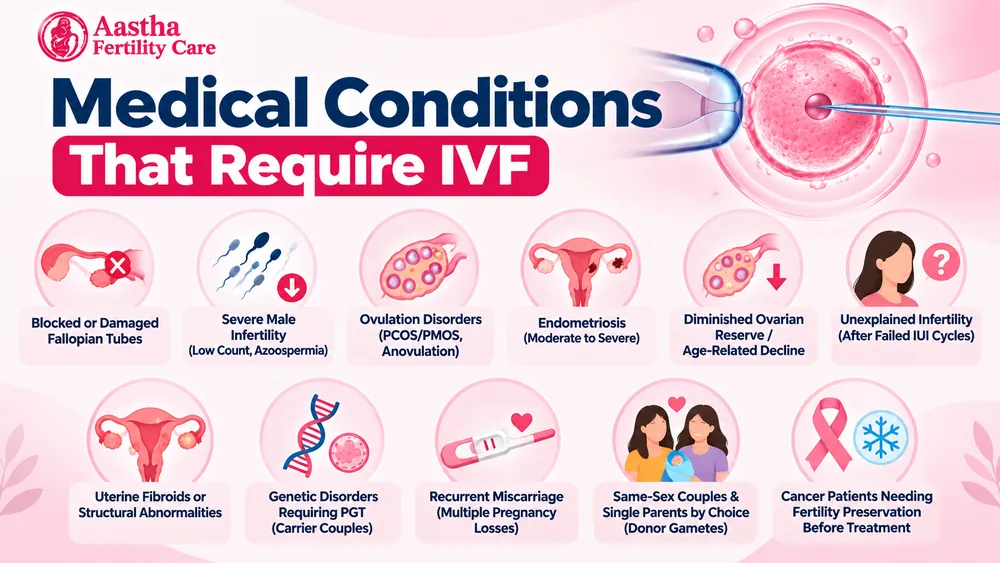
IVF treatment is most often recommended for couples facing infertility issues like blocked fallopian tubes, severe male factor infertility, ovulation disorders, moderate to severe endometriosis, low ovarian reserve, unexplained infertility, uterine problems, recurrent miscarriage, genetic risks, donor-gamete needs, and fertility preservation before cancer treatment. Here is what each of these conditions means:
Blocked or Damaged Fallopian Tubes
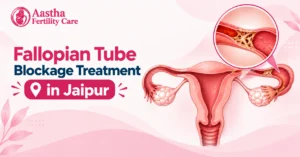
If both of the fallopian tubes are blocked, then the egg and sperm cannot meet naturally. Surgery may help only in selected cases, so IVF treatment, which bypasses the fallopian tubes, could be the best option. Read more about fallopian tube blockage treatment in Jaipur.
Severe Male Infertility (Low Count, Azoospermia)
Very low sperm count, poor motility, or lack of sperm in semen can make natural conception or IUI unlikely. IVF with ICSI places one sperm directly into each egg. Our male infertility services tell you about testing and options.
Ovulation Disorders (PCOS/PMOS, Anovulation)
PCOS/PMOS can lead to anovulation, which means your ovaries are unable to release a mature egg during a menstrual cycle. Many women with this diagnosis can get pregnant with ovulation-inducing drugs and timed intercourse or IUI. IVF is typically considered if these fail or other factors are present.
Endometriosis (Moderate to Severe)
Endometriosis is a serious condition which can scar the tubes and ovaries and impact egg quality. Moderate to severe cases often require IVF to improve the chances of pregnancy.
Diminished Ovarian Reserve / Age-Related Decline
When there is a decrease in the number of eggs in the ovary, you may need IVF treatment to collect multiple eggs during one cycle. According to ACOG, the number and quality of eggs start to decrease from the age of 30, and this reduction accelerates with age.
Life Changing Experiences with Aastha Fertility - From Doubt to Success
Unexplained Infertility (After Failed IUI Cycles)
Sometimes there is no apparent reason for infertility. Even with normal test results, there may be a hidden problem that stops conception during IUI cycles. In such cases, IVF can help get past the problem and also shows how your eggs and sperm behave in the lab.
Uterine Fibroids or Structural Abnormalities
Fibroids that change the shape of the uterine cavity, or other structural problems, can prevent the embryo from implanting. These are usually treated first, for example by removing the fibroid. IVF is advised if other causes, such as blocked tubes, sperm problems or advanced female age, are also present.
Genetic Disorders Requiring PGT (Carrier Couples)
PGT (preimplantation genetic testing) allows embryos to be screened so that healthy ones can be transferred to the woman’s uterus. Couples who are carriers of genetic disorders, such as thalassemia, have an opportunity to reduce the chance of passing the condition to their child. This method is useful in cases of family heredity.
Recurrent Miscarriage (Multiple Pregnancy Losses)
Unfortunately, some women lose more than one pregnancy. Doctors first look for the cause, and in selected cases, IVF with embryo screening may be advised. To receive detailed information about treatment of recurrent miscarriage in Jaipur, contact our clinic.
Cancer Patients Needing Fertility Preservation Before Treatment
Chemotherapy and radiation therapy can affect fertility in both women and men, so it is essential to preserve eggs, sperm or embryos before treatment begins. Our specialists offer embryo freezing to protect your fertility.
When Is IVF the Right Next Step?
IVF becomes the next step when other less aggressive treatments have failed, or if there are anatomical or physiological causes (tubal obstructions or severely diminished male fertility) that suggest that natural conception is unlikely to occur, or if time is of the essence (advanced maternal age, cancer treatment or medical urgency). Your physician considers these factors when determining your course of treatment.
1. After 3+ Failed IUI Cycles
Many couples will consider up to three IUI cycles prior to proceeding to IVF. Here is how many IUI cycles to try before IVF.
2. When Tubal or Severe Male-Factor Issues Prevent Natural Conception
If either or both tubes are blocked or if there is a severely diminished male fertility component, then proceeding directly to IVF may save you both time and money.
3. When a Fertility Window Is About to Close
If you are over 35 years of age, or if you are about to undergo cancer treatment, reducing the amount of time between diagnosis and treatment can be a crucial consideration. The quality and quantity of a woman’s eggs diminish with age.
IVF vs. Other Fertility Treatments
Lifestyle changes, ovulation medicines and IUI are usually tried first because they are simpler and less costly. IVF is more intensive but more effective for blocked tubes, severe male factor and age-related decline. Your diagnosis, not a fixed order, decides where to begin.
| Treatment | Best suited for |
| Medicines + timed intercourse | Ovulation problems |
| IUI | Mild male factor, unexplained infertility, open tubes |
| IVF | Blocked tubes, severe male factor, low reserve, repeated IUI failure |
IVF Treatment in Jaipur
At Aastha Fertility Care in Malviya Nagar, Dr. Namita Kotia goes through your reports, scans and timeline before suggesting whether you need IVF or a less aggressive approach. With the Chief Embryologist Dr. Ramdoss Srinivasan looking after the lab, you can continue your fertility journey without having to travel to Delhi or Mumbai.
Infertility affects an estimated 10 to 14 percent of Indian couples, so you are far from alone. Usually, your infertility consultation in Jaipur involves reviewing your reports, having a scan and discussing your options. For more on IVF treatment in Jaipur, see our complete guide.
Conclusion
There is nothing wrong with you if you need IVF. It only means that there is a different route to the goal you desire – a healthy baby in your arms. Whatever the reason for your IVF – blocked tubes, sperm issues, age, or something else – an accurate diagnosis will make it easier to navigate the next steps. So, book an infertility consultation in Jaipur with us.
FAQs – Who Needs IVF Treatment?
Considering IVF for the first time brings plenty of questions, and that is normal. These short answers cover age, male infertility, IUI, PCOS and eligibility in India. For advice based on your own reports, a consultation is always the best next step.
Is IVF only for older women?
No, IVF can be used at any age when it is required for conditions such as blocked tubes, severe male infertility or endometriosis. Age adds urgency but is not the only reason.
Can IVF help if the man has the fertility issue, not the woman?
Yes. With ICSI, one healthy sperm is injected into each egg, which helps when count or movement is low. Some men with no sperm in the semen can have sperm retrieved surgically.
Do you need IUI to fail before trying IVF?
Not always. IUI is often tried first when tubes are open and sperm is fairly normal. If both tubes are blocked, sperm counts are very low, or age is advancing, doctors may advise IVF directly.
Is IVF recommended for PCOS/PMOS?
Usually IVF is not recommended first. Most women start with lifestyle changes, ovulation medicines or IUI. IVF is advised if those fail or if tubes, sperm or age add complications.
Can single people do IVF in India?
Eligibility for single people or same-sex couples depends on India’s ART (Regulation) Act, 2021, and these rules can change. Our team explains what applies to you; read our guide to fertility laws in India.


Leave a comment