

Male infertility is a common condition that can affect a couple’s ability to conceive, even when there are no noticeable symptoms. Low sperm count, poor sperm quality, hormonal imbalances, or blocked sperm ducts may cause it. The right treatment depends on the underlying cause and may include lifestyle changes, medication, surgery, or advanced fertility treatments like IVF with ICSI. Early diagnosis and timely medical care can significantly improve the chances of achieving a successful pregnancy.
Can a man have completely normal health, a normal sex life, and still not be able to contribute to a child?
Yes, and it is more common than most people realize.
Many people still think infertility is only a woman’s concern. However, according to the Indian Council of Medical Research (ICMR), the male partner contributes to nearly 40–50% of infertility cases in India. The surprising part is that most men have no obvious symptoms and only discover the problem when pregnancy doesn’t happen despite regular unprotected sex.
If you or your partner are facing this situation, it’s natural to have questions about the cause, treatment, and whether becoming a parent is still possible.
“Male infertility is often treatable with the right diagnosis and timely care. Advanced treatments like ICSI and IVF have helped many couples overcome male fertility issues and achieve pregnancy.”
– Dr. Namita Kotia (MBBS, MS – Obstetrics & Gynaecology)
IVF Specialist & Director, Aastha Fertility Care, Jaipur
This blog will walk you through the symptoms, causes, diagnosis, and treatment of male infertility, along with how IVF for male infertility and ICSI can help many couples on their journey to parenthood.
What Is Male Infertility?
Male infertility simply means the male partner’s sperm isn’t able to fertilise the egg naturally. It’s not about masculinity, and it has nothing to do with how “healthy” or “fit” a man looks on the outside.
It can happen because of:
- Low sperm count
- Poor sperm movement (motility)
- Abnormal sperm shape
- Blockages that stop sperm from being released
A man can have a completely normal sex drive, normal ejaculation, and still be infertile.
Life Changing Experiences with Aastha Fertility - From Doubt to Success
Male Infertility Symptoms
Male infertility symptoms are often invisible. Most men don’t feel anything different in their day-to-day life. The only sign, for many, is that their partner isn’t getting pregnant despite trying for a year or more.
However, some men may experience symptoms such as:
- Difficulty getting their partner pregnant despite regular unprotected sex
- Low sex drive
- Pain, swelling, or a lump around the testicles
- Reduced facial or body hair (a sign of hormonal issues)
- Trouble with erections or ejaculation
These symptoms don’t always mean you have male infertility, but they shouldn’t be ignored either. If you notice any of them or have concerns about your fertility, it’s a good idea to consult a fertility specialist for a proper evaluation.
Causes of Male Infertility
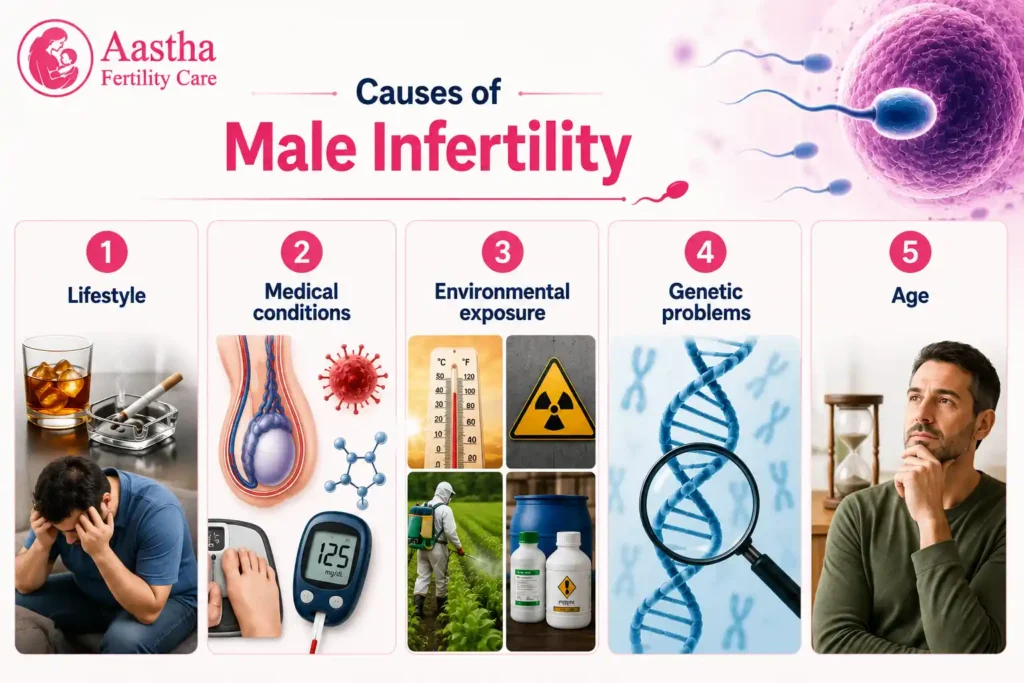
There are several different reasons for male infertility. It is important to find the exact cause because the right treatment depends on what is affecting fertility.
What are the common causes of male infertility?

1. Lifestyle – Excessive drinking, smoking, obesity, chronic stress, and a sedentary lifestyle can decrease sperm count gradually over a period of time.
2. Medical conditions – Common medical causes include varicocele (swollen veins in the scrotum), infections, hormonal imbalance, and diabetes.
3. Environmental exposure – Long-term exposure to heat, radiation, pesticides, or certain chemicals can damage sperm production.
4. Genetic problems – Some men are born with conditions that affect sperm production or block the release of sperm.
5. Age – Men can be fathers later in life, but the quality of sperm does tend to decrease slowly with age.
Diagnosis – How Male Infertility Is Confirmed
The first step in diagnosing male infertility is to identify the underlying cause. In most cases, the process begins with a semen analysis, which evaluates sperm count, sperm movement (motility), and sperm shape (morphology).
Depending on the results, your fertility specialist may recommend additional tests, such as:
- Hormone blood tests to check hormone levels
- Scrotal ultrasound to detect conditions like varicocele or other abnormalities
- Genetic testing if a hereditary condition is suspected
- A testicular biopsy in specific cases, such as suspected azoospermia, to check whether sperm is being produced
These tests are generally simple and safe. They help your doctor understand the exact cause of infertility so the most appropriate treatment plan can be recommended based on your individual condition.
IVF for Male Infertility — Why ICSI Works
IVF for male infertility has changed what used to be considered “untreatable.” And a lot of that credit goes to a technique called ICSI (Intracytoplasmic Sperm Injection).
Here’s how it works: in a regular IVF cycle, thousands of sperm are placed near an egg and left to fertilise it naturally in the lab. But with ICSI, the embryologist picks a single healthy sperm and injects it directly into the egg.
Why does this matter for men with fertility issues?
- If the sperm count is very low, ICSI doesn’t need thousands of sperm. Even a handful is enough.
- If sperm movement is poor, ICSI removes the need for the sperm to “swim” to the egg on its own.
- Even in cases of azoospermia (zero sperm in the ejaculate), sperm can sometimes be retrieved directly from the testicles through a minor procedure and used for ICSI.
This is the answer to a question many men are afraid to ask out loud: can a man with zero sperm count still have a biological child? In many cases, yes, thanks to ICSI combined with sperm retrieval techniques.
Other Male Infertility Treatment Options
IVF with ICSI isn’t always the first step. Depending on the cause, male infertility treatment can also include:
- Medication to correct hormonal imbalances
- Surgery to fix a varicocele or clear a blockage
- Lifestyle changes — quitting smoking, reducing alcohol, managing weight, and lowering stress
- IUI (Intrauterine Insemination) for mild cases, where sperm is placed directly into the uterus
- Sperm retrieval procedures like TESA/TESE for men with azoospermia
When to See a Doctor
If you and your partner have been trying to conceive for over a year (or six months, if the woman is above 35) without success, it’s time to see a fertility specialist. There’s no need to wait longer out of embarrassment or hope that things will “sort themselves out.”
The earlier the male partner also gets tested, the faster the actual problem gets identified, and the sooner both partners can move forward with a proper plan instead of just guessing.
Male Fertility Treatment in Jaipur
If you’re based in Jaipur or nearby and looking for reliable male infertility treatment in jaipur, having the right diagnostic setup and lab quality genuinely makes a difference. The need for precision in sperm retrieval, ICSI and embryo handling is where experience and technology come into play that impact on ICSI success rates.
Aastha IVF Centre, Jaipur, considers male infertility as equally important as female infertility and provides complete semen analysis, hormonal evaluation, and ICSI treatment in jaipur under one roof. You’re never left guessing because the team is 100% transparent about your reports, your chances, and the cost of your treatment.
Conclusion
Male infertility is more common than many people think, and the good news is that many cases can be treated successfully. Whether the issue is a low sperm count, poor sperm quality, or azoospermia, advanced treatments like IVF for male infertility with ICSI have helped many couples achieve pregnancy.
If you’ve noticed male infertility symptoms or your semen analysis shows abnormal results, don’t ignore them. Getting an early diagnosis can help identify the causes of male infertility and allow your fertility specialist to recommend the right male infertility treatment at the right time.
If you’re looking for expert guidance and personalized fertility care, the team at Aastha IVF Centre, Jaipur, is here to support you at every step of your parenthood journey.
FAQs
Can a man with zero sperm count still have a biological child?
Yes, in many cases. If sperm is being produced in the testicles but isn’t reaching the semen (a condition called obstructive azoospermia), doctors can retrieve sperm directly through a minor procedure and use it for ICSI.
Is ICSI more successful than regular IVF for male infertility?
For male-factor infertility specifically, yes. ICSI removes the need for sperm to fertilise the egg on its own, which makes it far more effective when sperm count or movement is low.
What is a normal sperm count?
According to WHO guidelines, a normal sperm count is generally considered to be 15 million sperm per millilitre of semen or higher. Anything lower may be classified as low sperm count, though fertility also depends on sperm movement and shape.
Can male infertility be reversed?
It depends on the cause. Lifestyle-related and hormonal causes often improve with treatment and habit changes. Structural issues like varicocele can be corrected with surgery. Genetic causes usually can’t be reversed but can often be worked around using ICSI.
How long does male infertility treatment take before trying IVF?
This varies from person to person. Mild cases may improve with 3-6 months of medication or lifestyle changes. More serious cases may move directly to IVF with ICSI after initial testing, especially if time is a factor for the couple.





Leave a comment