
Most couples with unexplained infertility may consider 3–4 cycles of IUI before moving to IVF , depending on their age and fertility assessment. However, some couples may need fewer cycles or may be advised to consider IVF sooner. Age, fallopian tube health, ovarian reserve, sperm quality and previous treatment response all influence this decision.
Trying to conceive and not getting pregnant can be heartbreaking. If you have opted for a fertility treatment it might not always work as you have planned. If you have previously chosen an IUI treatment which has been failed, you might be wondering if it’s time to move on to IVF treatment.
There’s no right or wrong answer when it comes to trying to get pregnant again. It depends on your age, diagnosis, ovarian reserve and sperm quality as well as how IUI has worked for you so far.
This article explores How Many IUI Cycles Should You Try Before IVF, how your age can play a crucial role in fertility treatment planning and when it might be time to talk with your fertility specialist about moving forward with IVF.
How Many IUI Cycles Should You Try Before IVF?
Many couples who have normal fertility but are not being able to conceive naturally usually choose to try multiple rounds of intrauterine insemination (IUI) before seeking further assistance from a IVF specialist.
According to the American Society for Reproductive Medicine (ASRM) , most fertility clinics recommend between 3-4 unsuccessful rounds of IUI prior to considering in vitro fertilization (IVF). However, this number can vary greatly depending on individual factors such as age and diagnosis.
IUI is a form of artificial insemination that involves placing washed and prepared sperm directly into the uterus during ovulation, allowing them to swim up the fallopian tubes where fertilization will occur if an egg is present.
While there’s no guarantee that any one round of IUI will result in pregnancy, some people find themselves pregnant on their very first attempt at the procedure!
Others may need more than one round before they’re able to become successfully pregnant. Every cycle offers new hope for conception while also presenting new challenges that must be overcome by both partners working together closely with their reproductive endocrinologist throughout treatment planning discussions following each unsuccessful attempt at becoming pregnant using this particular method.
IUI Success Rates by Cycle Number
IUI success depends on a number of variables including the woman’s age, cause of infertility, ovulation, sperm counts and motility, and patency of the fallopian tubes.
Life Changing Experiences with Aastha Fertility - From Doubt to Success
Success rates can vary significantly between different clinics and reports. Furthermore, there is a difference between positive pregnancy tests, clinical pregnancies, and live births.
| IUI cycle | What it means |
|---|---|
| First cycle | An initial opportunity to assess treatment response and pregnancy outcome. |
| Second cycle | Another opportunity if IUI remains appropriate. |
| Third cycle | A common point to review cumulative treatment results and the next steps. |
| Fourth cycle | May be considered for selected couples after reviewing age, diagnosis and previous response. |
Important: These are all milestones but not guarantees for every couple at every stage. There is no magic percentage that applies to all couples at all numbers of cycles.
If multiple IUI cycles have failed, and the timing is right, speak with your fertility specialist about re-evaluating the diagnosis and considering whether progressing to IVF may be a more appropriate course of treatment.
Recommended IUI Cycles by Age
While there are various factors that contribute to you getting pregnant, women’s age tends to be a significant indicator for any pregnancy planning.
Her age can impact the number of eggs retrieved, the quality of the eggs retrieved, and the likelihood of chromosomal abnormalities.

While age is a crucial consideration, your individualized fertility profile will also play a role in the recommendation.
Under 35 years
Women younger than 35 tend to have more flexibility in their fertility treatment options if the diagnosis indicates that IUI is appropriate. For example, IUI may be considered for couples with unexplained or mild male-factor infertility.
Your specialist may reevaluate the treatment plan after every cycle and discuss the appropriateness of continuing IUI.
While young age is an advantage for IUI, it is not a guarantee for pregnancy in all scenarios, such as in the presence of significant tubal damage or severe sperm abnormalities.
Between 35 and 37 years
Women between the ages of 35 and 37 years may notice a decrease in egg reserve and hence a reduced fertility potential compared to women younger than 35 years.
In this age group, it is essential to think about the entire picture when formulating a treatment plan. It is important to have a discussion with your doctor about timelines to conceive before initiating IUI.
Your doctor may take into account:
- How long you have been trying to conceive
- Your ovarian reserve and ovulation potential
- The patency of your fallopian tubes
- Your partner’s semen analysis
- Any prior fertility treatment
Based on this information, some couples may benefit from a limited number of IUI cycles, while others may be counseled to consider IVF.
Between 38 and 40 years
As women age beyond 38 years, age becomes an increasingly important consideration when planning fertility treatment.
The likelihood of conceiving with IUI may decrease. It is important to consider IVF sooner rather than later if ovarian reserve or egg quality are concerns.
It is important to have a discussion with your doctor to understand your individual circumstances rather than applying broad assumptions.
Above 40 years
IUI treatment planning for women older than 40 years tends to be more time-sensitive.
Your doctor may counsel you to consider earlier intervention with IVF, depending on ovarian reserve, medical history, and other fertility investigations.
IUI may still be an option in select cases, but it is important to understand the limitations, time constraints, and other available options before pursuing treatment.
Key considerations: There is no hard and fast rule about how many IUI cycles you should complete before pursuing other treatment based solely on age. The most appropriate course of action depends on individual fertility investigations as well as the amount of time that a couple is considering pursuing fertility treatment.
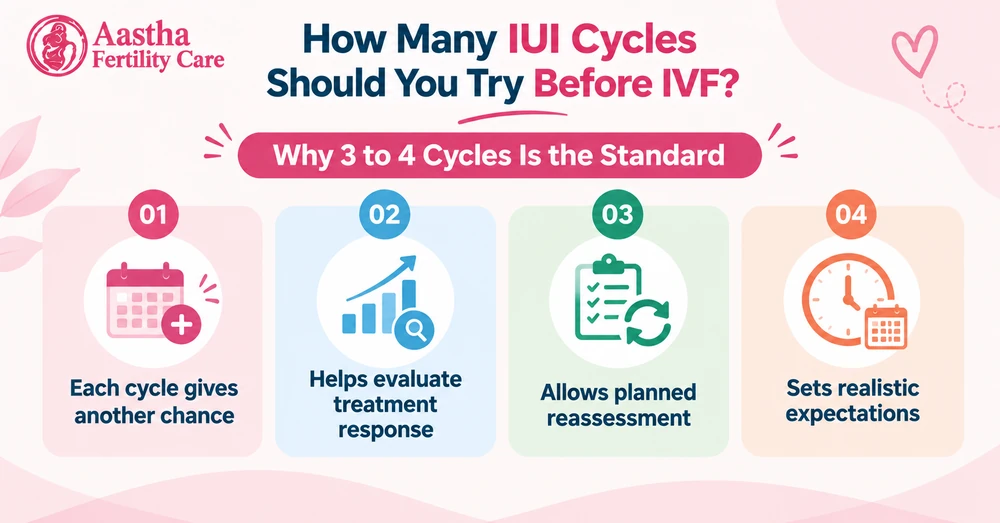
Why 3 to 4 Cycles Is the Standard
The 3–4 cycle standard mainly applies to couples with unexplained infertility who are undergoing ovarian stimulation plus IUI with oral medications. ASRM recommends a limited number of cycles for many couples considering IUI before pursuing IVF.
There are several reasons why this recommendation is made:
1. Every cycle provides an additional opportunity for pregnancy
IUI is performed at the time of ovulation. Each cycle, therefore, provides an additional opportunity for pregnancy, although there is no guarantee that any given cycle will be successful.
2. There is an opportunity to evaluate response to treatment
Your fertility specialist can identify whether ovulation has occurred, how your body responded to ovarian stimulation, and whether the timing of IUI was appropriate for your cycle.
3. There is value in having a planned reassessment
After multiple cycles have failed, it is essential to reevaluate the diagnosis and consider other treatment options.
4. It is important to establish realistic expectations about treatment timelines
Fertility treatment involves numerous steps, appointments, expenses, and emotional investment. It can be valuable to establish a baseline understanding of when treatment may need to be reconsidered.
When to Switch to IVF Sooner
There are certain situations where pursuing IVF sooner rather than later may be more appropriate, even before 3–4 IUI cycles.
These circumstances do not necessarily indicate that IUI is a failed treatment option, but rather that further IUI cycles would provide limited benefit based on individual factors.
1. Blocked or damaged tubes
IUI is not appropriate if the fallopian tubes are blocked or damaged because the egg and sperm cannot meet in this scenario.
IVF may be a better option in this situation, as embryo transfer can by-pass the fallopian tubes entirely.
2. Severe male factor infertility
If your partner’s semen analysis shows severely abnormal sperm count or motility, IUI may not be appropriate.
Depending on the exact diagnosis, other options such as IVF or ICSI may be considered.
3. Reduced ovarian reserve
Ovarian reserve testing is important in predicting your current eggs reserves and planning appropriate treatment.
A low ovarian reserve does not necessarily eliminate pregnancy possibilities, but it may impact treatment timing and options.
4. Age-related infertility concerns
Women who are older than 35 years may find that fertility declines faster with age and that other treatment options may need to be considered sooner.
5. Endometriosis or other fertility concerns
Endometriosis, as well as other reproductive conditions, can impact fertility in different ways depending on the severity of the diagnosis and specific factors involved.
6. Multiple failed IUI cycles
If multiple IUI cycles have failed, your fertility specialist will need to reassess your diagnosis and discuss whether IVF may be appropriate.
IUI vs. IVF — Key Differences
IUI and IVF are different fertility treatments. Neither is suitable for every couple.
IUI (Intrauterine Insemination)
- Prepared sperm is placed inside the uterus.
- Fertilization occurs inside the body.
- Usually involves ovulation monitoring and may include medication.
- Does not require egg retrieval.
IVF (In Vitro Fertilization)
- Eggs are collected from the ovaries.
- Eggs are fertilized with sperm in a laboratory.
- Embryos are monitored before transfer.
- Requires ovarian stimulation and an egg retrieval procedure.
| Factor | IUI | IVF |
|---|---|---|
| Where fertilization occurs | Inside the body | In a laboratory |
| Egg retrieval | Not required | Required |
| Treatment complexity | Generally simpler | More involved |
| Suitable for | Selected fertility conditions | A wider range of fertility conditions |
| Main considerations | Ovulation, sperm and tube health | Age, egg and embryo factors, diagnosis |
Signs Your Current IUI Cycle Isn’t Working
It is essential to distinguish between one failed IUI cycle and multiple failed IUI cycles, as both scenarios have very different implications.
A single negative pregnancy test usually does not indicate that treatment should be stopped or that it is time to pursue other treatment options.
There are some circumstances in which your specialist may recommend considering other options.
Pregnancy has not occurred after several IUI cycles
A number of negative pregnancy tests can be discouraging.
It is important to speak with your specialist about whether further IUI cycles are appropriate based on your individual circumstances.
Ovulation is not responding to stimulation
If your fertility specialist has determined that ovulation is not occurring appropriately, it may be time to discuss alternate treatment options.
The underlying diagnosis has changed
Your specialist may also consider other options if new information emerges that indicates a change in your diagnosis.
Your treatment timeline needs to be reevaluated
Your specialist may also need to reassess your treatment timeline based on your age, ovarian reserve, and other factors that impact fertility.
It is essential to speak with your fertility specialist about all of these factors rather than making treatment decisions based on symptoms alone.
IUI to IVF Transition in Jaipur – Aastha’s Approach
At Aastha Fertility Care, Jaipur , we work with you to determine whether it is appropriate to continue with IUI or consider transitioning to IVF.
We will go over the following steps:
Step 1: We review past IUI cycles
The fertility specialist will go over your previous IUI treatment course, including:
- Number of IUI cycles
- Ovulation and associated follicular development
- Medication and treatment response
- Insemination timing
- Pregnancy test results
All of this information will be used to understand your situation better and determine what the next step should be.
Step 2: We reassess your fertility
Additional testing and evaluation may be recommended to determine whether any factors are impacting your fertility and influencing your specialist’s recommendations for future treatment.
Depending on your specific circumstances, this could involve ovarian reserve testing , IVF consultation , tubal patency testing, or semen analysis. The goal is to understand how any underlying factors could influence future treatment decisions.
Step 3: We discuss your options for IUI and IVF
Your fertility specialist can discuss options for both IUI and IVF , including potential benefits and limitations of both procedures, as well as estimated timelines.
For some women, another round of IUI may still be a reasonable option, while others may be encouraged to move on to IVF or IVF with ICSI.
Step 4: We plan the next steps together
Your fertility treatment plan should be individualized based on your specific circumstances.
It is essential to talk to your specialist about your expectations for treatment and the financial considerations involved.
Conclusion
For many couples, 3-4 intrauterine insemination (IUI) cycles may be attempted prior to proceeding to in Vitro Fertilization (IVF). This is not always the case, however, for every patient.
Patient age, ovarian reserve, fallopian tube function, sperm parameters and treatment response are all factors that must be taken into consideration.
If you have tried multiple insemination cycles without success it is a good idea to have an open discussion with your doctor about your options.
There is no right or wrong number of cycles to attempt before seeking a different form of treatment.
FAQs
1. How many IUI cycles should you try before going to IVF?
Many couples undergoing treatment for unexplained infertility can expect to have 3-4 cycles of ovarian stimulation with oral contraceptives combined with an IUI prior to proceeding to IVF. The number of cycles that should be attempted should be determined by your age, diagnosis and treatment response. The American Society for Reproductive Medicine (ASRM) .
2. Is it worth trying more than 3 IUI cycles?
It may be worthwhile to continue with inseminations for some couples. The decision to continue trying with IUI should be made by you and your doctor based on your age, diagnosis, previous treatment response, and expected benefit.
3. Should women over the age of 35 skip IUI and go straight to IVF?
Many women can and do benefit from IUI regardless of age. There are instances, however, where IUI may not be the best option at the time of diagnosis.
4. When should you consider going to IVF after failed IUI?
IVF may be considered following multiple failed IUI cycles. There are specific cases in which it is appropriate to move to IVF sooner, however, such as in the presence of tubal factor infertility, severe male factor infertility or diminished ovarian reserve.
5. Does IVF have a higher success rate than IUI?
Success rates tend to be higher with IVF in comparison to IUI, but the rates of success vary from patient to patient and from diagnosis to diagnosis. There is no single treatment approach that is right for every patient.
6. Can you have an IUI every month?
In certain instances an IUI can be performed on a monthly basis. This is a decision that should be made jointly by you and your physician based on your response to medication and other factors.
7. Is IVF the next step after failing IVF four times?
IVF is generally considered for many patients who have failed IUI treatment. This is not always the case, however, and treatment options should be reviewed and considered on a case by case basis.




Leave a comment