

For many couples undergoing IVF treatment, embryo transfer is one of the most important stages of the fertility journey. Even when good-quality embryos are available, implantation does not always happen. This can leave couples wondering whether something is affecting the uterus or the timing of embryo transfer.
One test that has received attention in this context is the Endometrial Receptivity Analysis (ERA) test. It is designed to assess whether the uterine lining is receptive to an embryo at the time when transfer is planned.
But is the ERA test necessary for everyone undergoing IVF? Can it improve implantation or pregnancy rates? And who may benefit from it?
Let’s understand how the ERA test works, its procedure, cost, limitations and the current scientific evidence.
What Is the ERA Test?
The ERA (Endometrial Receptivity Analysis) test is a molecular diagnostic test that examines the endometrium, or uterine lining, to assess its receptivity.
The endometrium changes throughout the menstrual cycle under the influence of hormones, particularly progesterone. During a specific period known as the window of implantation (WOI), the uterine lining becomes receptive to an embryo.
In some women, this window may occur earlier or later than expected. The ERA test analyses the expression of selected genes in an endometrial biopsy sample to classify the lining as receptive, pre-receptive or post-receptive.
The results may help a fertility specialist determine whether the timing of embryo transfer should be adjusted.
What Is the Window of Implantation?
The window of implantation is a limited period during which the endometrium is biologically prepared for an embryo to attach and begin implantation.
In a typical IVF cycle, embryo transfer is scheduled according to the patient’s hormonal preparation and the developmental stage of the embryo.
Life Changing Experiences with Aastha Fertility - From Doubt to Success
However, the timing of endometrial receptivity may vary between individuals. If the embryo and endometrium are not synchronised, implantation may be affected.
The ERA test aims to identify this timing in selected patients so that the fertility specialist can consider adjusting the embryo transfer schedule.
Why Is the ERA Test Done?
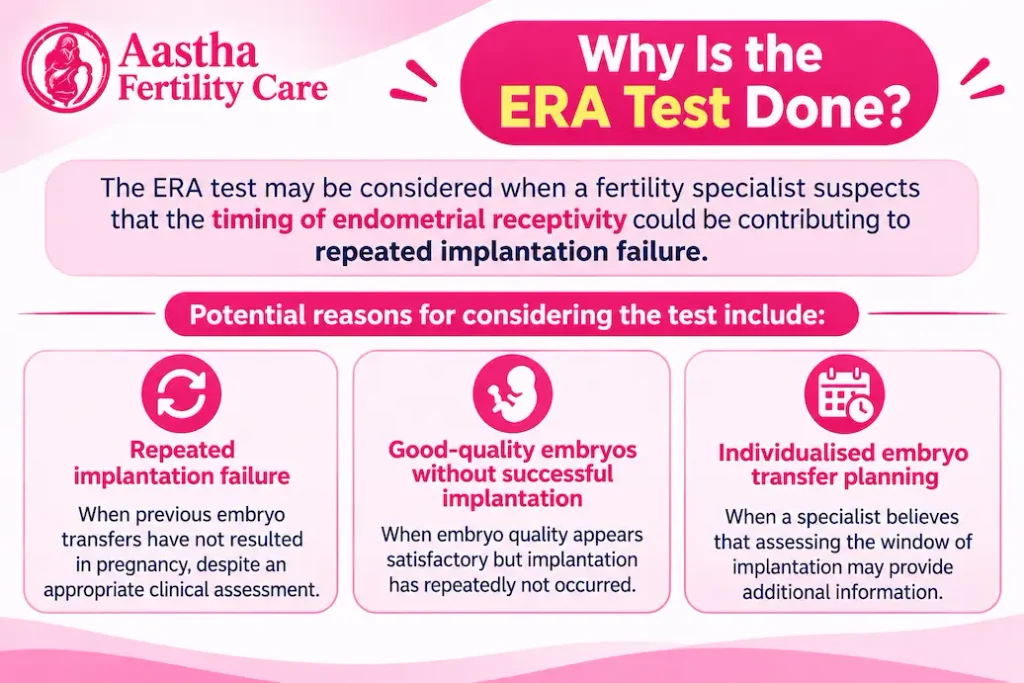
The ERA test may be considered when a fertility specialist suspects that the timing of endometrial receptivity could be contributing to repeated implantation failure.
Potential reasons for considering the test include:

- Repeated implantation failure: When previous embryo transfers have not resulted in pregnancy, despite an appropriate clinical assessment.
- Good-quality embryos without successful implantation: When embryo quality appears satisfactory but implantation has repeatedly not occurred.
- Individualised embryo transfer planning: When a specialist believes that assessing the window of implantation may provide additional information.
It is important to understand that implantation failure can have several causes. These may include embryo-related factors, uterine abnormalities, hormonal factors and other medical conditions. The ERA test does not identify or rule out all these causes.
You can also read about IVF failure reasons to understand the different factors that may affect treatment outcomes.
Who Should Consider the ERA Test?
The ERA test is not routinely recommended for every woman undergoing IVF.
A fertility specialist may discuss it in selected cases, particularly when there has been repeated implantation failure and other relevant factors have been evaluated.
The decision should take into account:
- Previous IVF and embryo transfer history.
- Number and quality of embryos transferred.
- Uterine and endometrial assessment.
- Hormonal preparation and progesterone exposure.
- Other possible explanations for unsuccessful implantation.
A detailed IVF failure consultation can help assess whether further testing is appropriate.
How Is the ERA Test Performed?
The ERA test generally involves an endometrial biopsy followed by molecular analysis of the collected tissue.
The process usually includes the following steps:
1. Preparation of the Endometrium
The endometrium is prepared using a protocol prescribed by the fertility specialist. This may involve hormonal medication to replicate the conditions of a frozen embryo transfer cycle.
2. Endometrial Biopsy
A small sample of tissue is collected from the uterine lining using a thin instrument inserted through the cervix.
The biopsy is generally performed without major surgery. Some women may experience temporary cramping or mild discomfort.
3. Laboratory Analysis
The tissue sample is sent to a specialised laboratory for molecular analysis. The test examines the expression of selected genes associated with endometrial receptivity.
4. Interpretation of Results
The laboratory report classifies the endometrium according to its receptivity status.
Based on the findings, the fertility specialist may determine whether the planned timing of embryo transfer needs to be adjusted.
What Do ERA Test Results Mean?
ERA reports generally classify the endometrium into three categories:
| Result | Meaning |
|---|---|
| Receptive | The endometrium appears to be within the predicted window of implantation. |
| Pre-receptive | The endometrium may not yet have reached the predicted receptive stage. |
| Post-receptive | The endometrium may have passed the predicted receptive stage. |
If the report indicates a pre-receptive or post-receptive result, the specialist may consider modifying the duration of progesterone exposure before embryo transfer.
The result should always be interpreted alongside the patient’s medical history and other investigations. It does not guarantee successful implantation or pregnancy.
Does the ERA Test Improve IVF Success Rates?
This is one of the most important questions for couples considering the test.
The ERA test may provide information about the timing of endometrial receptivity. However, there is currently insufficient evidence to recommend routine ERA testing for all IVF patients or to conclude that it improves live birth rates.
A randomised clinical trial published in JAMA included 767 women and compared receptivity-guided embryo transfer with standard embryo transfer timing. The live birth rate was 58.5% in the receptivity-guided group and 61.9% in the standard-timing group. The difference was not statistically significant.
The European Society of Human Reproduction and Embryology (ESHRE) has also discussed the limitations of available evidence and does not support routine use of commercially available endometrial receptivity tests for recurrent implantation failure.
Read ESHRE recommendations on recurrent implantation failure.
Therefore, the ERA test should be considered selectively rather than as a standard test for every IVF cycle.
What Is the Cost of the ERA Test in India?
The cost of an ERA test in India can vary depending on the diagnostic laboratory, testing method, clinic and location.
The overall expense may include:
- Endometrial biopsy procedure.
- Laboratory sample processing.
- Molecular analysis.
- Consultation and interpretation of results.
Patients should confirm the complete cost with their fertility clinic before proceeding. The need for additional investigations or a customised embryo transfer cycle may also affect the overall treatment expense.
What Happens After the ERA Test?
After receiving the ERA report, the fertility specialist reviews the findings and decides whether any changes to the embryo transfer plan are appropriate.
If the report indicates that the window of implantation may differ from the expected timing, the specialist may consider adjusting progesterone exposure before a subsequent transfer.
The next step may involve a frozen embryo transfer (FET), depending on the treatment plan.
The decision should also consider embryo quality, uterine health, hormonal response and previous treatment outcomes.
Is the ERA Test Necessary Before Every IVF Transfer?
No. The ERA test is not necessary before every IVF transfer.
Many patients undergo successful IVF treatment without this test. Current evidence does not establish a clear benefit from routinely performing ERA testing in all patients.
A fertility specialist should recommend it only when the patient’s clinical history and previous treatment outcomes suggest that the information may be useful.
ERA Test at Aastha Fertility Care, Jaipur
At Aastha Fertility Care, the fertility evaluation and treatment plan should be based on each patient’s medical history, previous IVF outcomes and individual requirements.
Dr. Namita Kotia, an IVF specialist, can help patients understand their fertility investigations and discuss whether additional testing may be appropriate.
Patients considering IVF treatment in Jaipur can discuss their previous treatment history, available investigations and possible next steps with the fertility team.
For information about the clinic and its fertility services, visit Aastha Fertility Care or contact the clinic.
Conclusion
The ERA test is designed to assess the timing of endometrial receptivity and may provide additional information in selected IVF cases.
However, it is not a guaranteed solution for implantation failure, and current research does not support its routine use for every IVF patient.
The most appropriate approach is to identify possible reasons for unsuccessful embryo transfers through a comprehensive fertility evaluation and discuss the potential benefits and limitations of additional testing with an experienced fertility specialist.
Frequently Asked Questions About the ERA Test
1. What is the ERA test in IVF?
The ERA test, or Endometrial Receptivity Analysis, is a molecular test that examines an endometrial biopsy sample to assess whether the uterine lining is receptive to embryo implantation.
2. Is the ERA test painful?
The ERA test involves collecting a small sample of the uterine lining. Some women experience mild cramping or discomfort during the biopsy, which is generally temporary.
3. Who should undergo an ERA test?
It may be considered in selected patients with repeated implantation failure after a fertility specialist has reviewed their medical and treatment history. It is not routinely recommended for everyone undergoing IVF.
4. Can the ERA test increase IVF success rates?
The test may help assess the timing of endometrial receptivity, but current clinical evidence has not established that routine ERA testing improves live birth rates.
5. What is the normal ERA test result?
A receptive result indicates that the endometrium appears to be within the predicted window of implantation. Other results may indicate that the lining is pre-receptive or post-receptive.
6. What is the cost of an ERA test in India?
The cost varies by laboratory, clinic and location. Patients should confirm the total cost, including biopsy and laboratory analysis, with their fertility clinic.
7. Is the ERA test necessary before a frozen embryo transfer?
No. It is not necessary before every frozen embryo transfer. A fertility specialist may consider it in selected cases based on previous IVF outcomes and clinical findings.





Leave a comment