
Mini IVF is a type of fertility treatment that uses lower doses of fertility medications to stimulate the ovaries and retrieve fewer eggs. It is often considered for women with low AMH, poor ovarian reserve or those wanting a less intensive IVF approach. Mini IVF is a more natural approach to conventional IVF with less medication, treatment burden, and risk of complications; it’s a personalized option for selected fertility patients, while working with the body’s natural response.
Have you been told that your AMH is low and now you’re worried about your pregnancy chances?
You’re not alone. Many women immediately think that low AMH means no pregnancy or IVF. But fertility treatment has changed significantly over the years. Today, doctors can tailor IVF protocols based on a woman’s ovarian reserve, and in some cases, a low-dose approach like Mini IVF may be recommended instead of aggressive stimulation.
“Mini IVF has helped many women with low ovarian reserve undergo fertility treatment with a more tailored and less intensive approach,” says Dr. Namita Kotia (MBBS, MS – Obstetrics & Gynaecology), Jaipur.
According to him, the focus is not always on collecting the highest number of eggs, but on choosing the right treatment strategy for each patient.
If you are exploring low AMH fertility options or looking for gentle IVF treatments, this blog will help you understand what is mini IVF, how Mini IVF works and what its benefits are.
Conventional IVF vs. Mini IVF: The Core Functional Differences
Before going further, let’s take a moment to understand how Mini IVF is different from the conventional IVF most people have heard of.
Traditional IVF treatment is aimed at stimulating the ovaries to produce as many eggs as possible in one cycle. Usually this is done with higher doses of fertility drugs.
Mini IVF, on the other hand, is designed to retrieve a smaller number of eggs with lower doses of medication.
The point is not necessarily to get as many eggs as you can. It’s about working with the body’s natural response and minimizing exposure to drugs.
Life Changing Experiences with Aastha Fertility - From Doubt to Success
Your query will be clear with this table
| Factor | Conventional IVF | Mini IVF |
| Medication Dose | Higher | Lower |
| Number of Eggs Expected | More | Fewer |
| Cost of Medications | Higher | Lower |
| Injection Requirement | More | Less |
| Risk of OHSS | Higher | Lower |
| Monitoring Visits | More Frequent | Often Fewer |
| Treatment Intensity | Higher | Milder |
Many patients assume that collecting more eggs automatically means better success. However, fertility specialists know that the relationship between egg quantity and treatment success is more complex.
This is why Mini IVF has become one of the increasingly discussed low AMH fertility options for certain patients.
Now let’s look at how this approach actually works.
The Medical Protocol: How Mild Stimulation Works
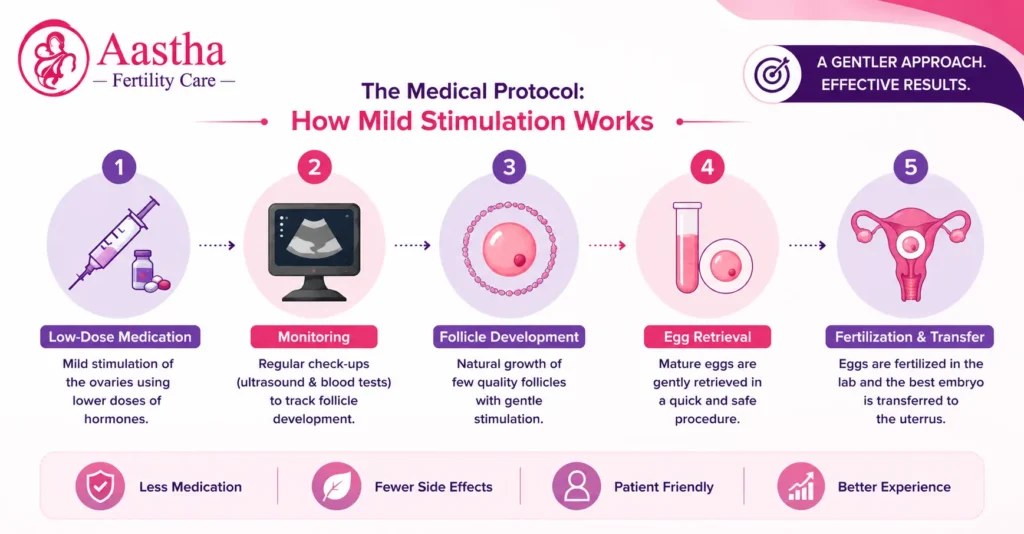
The foundation of Mini IVF is the mild stimulation IVF protocol.
Instead of relying primarily on high-dose injectable medications, this protocol often combines oral fertility medications with lower-dose hormone injections.
A typical mild stimulation IVF protocol may include:
Step 1: Oral Fertility Medication
Treatment often begins with oral medications such as:
These medications encourage the ovaries to recruit and mature follicles.
Step 2: Low-Dose Injectable Hormones
Smaller amounts of injectable fertility hormones may be added to support follicle growth.
Because the doses are lower, patients often experience:
- Fewer injections
- Lower medication costs
- Reduced treatment burden
Step 3: Monitoring
Ultrasounds and blood tests help doctors monitor follicle development and determine the ideal timing for egg retrieval.
Step 4: Egg Retrieval
Once the follicles are mature, eggs are collected through the standard IVF egg retrieval procedure.
Step 5: Fertilization and Embryo Development
The retrieved eggs are fertilized in the laboratory and allowed to develop into embryos before transfer or freezing.
The process may sound similar to conventional IVF, but the overall treatment intensity is often lower.
Who Benefits Most from a Mild Stimulation IVF Protocol?
Mini IVF is not suitable for everyone. However, certain groups of patients may benefit significantly from this approach.
Let’s take a closer look at it.
1. Women with Severely Low AMH or Poor Ovarian Response
Women with low AMH often produce fewer eggs regardless of how aggressively the ovaries are stimulated.
However, Higher doses of medication will not always give dramatically better egg numbers in these cases. For some women, Mini IVF offers a more practical and personalized treatment plan.
It is one of the most commonly discussed low AMH fertility options as it is about getting the best response you can realistically get.
When ovarian reserve is already limited, many fertility specialists believe treatment should be tailored to the body’s natural capacity, rather than forcing an aggressive response.
But low AMH is not the only reason doctors may propose Mini IVF.
2. Patients at Extreme Risk for OHSS (e.g., Severe PCOS)
OHSS (Ovarian Hyperstimulation Syndrome) is a complication that can occur when the ovaries respond too strongly to fertility medications.
Women with severe PCOS are often at increased risk.
Symptoms may include:
- Abdominal bloating
- Pelvic discomfort
- Nausea
- Fluid retention
Because Mini IVF uses lower medication doses, the risk of OHSS can often be reduced.
This makes it one of the gentle IVF treatments for selected patients who are highly sensitive to ovarian stimulation.
Safety is one of the major reasons why many fertility specialists consider Mini IVF in carefully chosen cases.
But there is another group of patients who may also appreciate this approach.
3. Couples Looking for Less Medically Intensive Options
Not every patient feels comfortable with high medication doses and intensive treatment schedules.
Some couples prefer a fertility treatment plan that:
- Uses fewer medications
- Requires fewer injections
- Feels less physically demanding
- Involves lower medication costs
For these patients, Mini IVF may provide a more manageable experience.
But it’s also important to temper expectations with reality. Mini IVF has its advantages, but it also has its limitations.
Realistic Expectations: Quality of Eggs vs. Quantity of Embryos
One of the biggest myths in IVF is that collecting more eggs automatically means better results. While having more eggs can increase the number of embryos available, the quality of those eggs often matters more than the quantity.
A simple way to understand this difference is through the comparison below:
| Focus Area | Mini IVF | Conventional IVF |
| Main Goal | Prioritize egg quality and patient comfort | Maximize the number of eggs collected |
| Medication Dose | Lower | Higher |
| Eggs Retrieved | Usually fewer | Usually more |
| Embryos Created | May be fewer | Often more |
| Treatment Intensity | Less intensive | More intensive |
| Risk of OHSS | Lower | Higher |
| Best Suited For | Low AMH, poor responders, OHSS risk | Patients expected to respond well to stimulation |
Mini IVF is not about getting the maximum number of eggs. It’s about working with your body’s natural response while minimizing medication exposure. For some women, especially those with a low ovarian reserve, this method can give a more balanced and more pleasant treatment experience.
This is why Mini IVF success should not be measured by the number of eggs retrieved. What is often more important is the quality of the eggs, the health of the embryos and selecting the right treatment protocol for your situation.
Conclusion
Mini IVF represents a more personalized approach to fertility treatment. By using a mild stimulation IVF protocol, it aims to reduce medication exposure while still supporting egg development and embryo creation.
For women exploring low AMH fertility options, patients at high risk for OHSS, or couples interested in gentle IVF treatments, Mini IVF may offer a practical alternative to conventional IVF. However, it is important to understand that success depends on individual factors rather than the treatment name itself.
At Aastha IVF & Fertility Centre, Jaipur, our experienced fertility specialists carefully evaluate ovarian reserve, hormone levels, age, and previous treatment history before recommending a personalized treatment plan. Through advanced fertility care and evidence-based treatment strategies, we help couples make informed decisions on their journey toward parenthood.
FAQ: What is Mini IVF?
What is Mini IVF?
Mini IVF is a type of IVF treatment that uses lower doses of fertility medicines to stimulate the ovaries and collect fewer but good-quality eggs.
How is Mini IVF different from regular IVF?
Regular IVF uses higher-dose stimulation to collect more eggs, while Mini IVF uses low-dose medicines and focuses on a gentler, lower-cost approach.
Who is Mini IVF suitable for?
Mini IVF may be suitable for women with low ovarian reserve, poor response to previous IVF cycles, PCOS, or those who want a less intensive IVF option.
Is Mini IVF painful?
Mini IVF is generally not painful. Some women may feel mild discomfort during injections or egg retrieval, but the process is usually well tolerated.
What is the success rate of Mini IVF?
Mini IVF success depends on age, egg quality, sperm quality, embryo health, and fertility condition. Your doctor can guide you based on your reports.
Is Mini IVF cheaper than regular IVF?
Mini IVF may cost less than regular IVF because it uses fewer medicines, but the total cost depends on tests, procedures, and individual treatment needs.

Leave a comment