
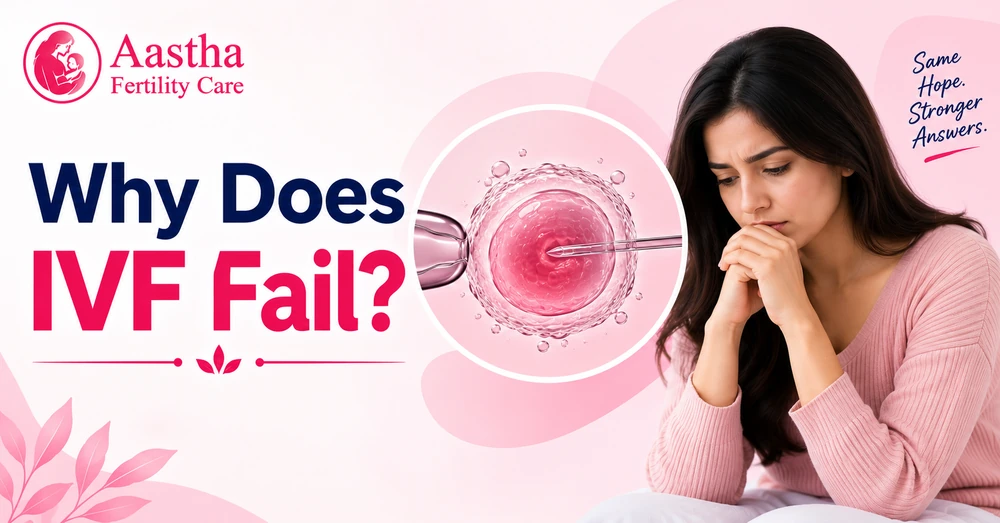
IVF can fail for many reasons. The embryo may have chromosome abnormalities, the eggs or sperm may be of poor quality, the uterus may have conditions, hormone problems, or sometimes no problem at all . Knowing the reasons for IVF failure can help couples and their fertility specialist review the last cycle and decide what to do next. Poor embryo development, implantation problems, or uterine problems are common causes of IVF failure. One failed cycle does not mean that future IVF attempts cannot be successful.
Did your IVF cycle fail even after you had a good-quality embryo, and now you are wondering what went wrong?
After putting so much hope, time, and effort into IVF, a negative pregnancy test can feel deeply disappointing. You may start asking yourself whether the embryo was not strong enough, whether your body did not support implantation, or whether something was missed during treatment. The truth is that IVF can fail even when everything appears to have gone well, and one failed cycle does not always mean that your next attempt will have the same result.
Aastha Fertility Care’s Director and IVF Specialist Dr. Namita Kotia (MBBS, MS – Obstetrics & Gynaecology) explains that IVF success depends on several factors, including embryo health, egg and sperm quality, the uterus, hormones, and the timing of embryo transfer. A detailed review after a failed cycle can help you understand what may have affected the outcome instead of simply repeating the same treatment.
If you are searching for why does IVF fail, this blog will help you understand the common IVF fail reasons, what implantation failure means, and what you can discuss with your fertility specialist before trying again.
What Does IVF Failure Mean?
An unsuccessful IVF cycle means that the treatment has not led to a successful pregnancy. This can happen at different levels. Sometimes a fertilised egg will not grow as it should in the laboratory, but in other cases the fertilised egg may be transferred but not implant, or the pregnancy may stop growing.
One failed IVF cycle doesn’t necessarily mean you have a serious fertility problem. In fact, there are many factors that impact IVF success, and sometimes no one thing can be identified as the cause.
Why Does IVF Fail – 12 Reasons
Why does IVF fail even when you have followed the treatment carefully?
There can be several reasons. Some are related to the embryo, some to the uterus or hormones, and some may remain unexplained even after detailed evaluation. Current fertility guidance also stresses that extensive testing is not automatically needed after every failed transfer.
1. Embryo Chromosomal Abnormalities (Aneuploidy)
An embryo may look healthy under a microscope but still have an abnormal number of chromosomes, known as aneuploidy.
Life Changing Experiences with Aastha Fertility - From Doubt to Success
Why it matters: Chromosomally abnormal embryos have a much lower chance of continued implantation and live birth, and age-related embryo aneuploidy is considered an important cause of implantation failure.
2. Poor Egg Quality (Age-Related or PCOS-Related)
Egg quality changes with age naturally, but conditions such as PCOS can impact ovulation and the overall fertility picture. Age-related decline in egg quality often overlaps with a lower ovarian reserve, which is why doctors often look at both together.
Why it matters: Egg quality is important for fertilisation, embryo development and the chances of creating an embryo that can continue to develop after transfer.
3. Sperm DNA Fragmentation
Sometimes a semen report may look acceptable, but the DNA inside the sperm may have damage. A semen analysis is usually the starting point for evaluating this.
Why it matters: Sperm health contributes to embryo development, although current evidence is not strong enough to recommend sperm DNA fragmentation testing routinely for recurrent implantation failure.

4. Thin or Unreceptive Endometrial Lining
The embryo has to implant into the lining of the uterus, the endometrium. If the lining doesn’t form properly, your doctor may investigate the reason. Read more about thin endometrium, its causes, and treatment here.
Why it matters: A healthy uterine environment is critical for embryo implantation and early pregnancy development.
5. Implantation Window Mismatch (ERA-testable)
The embryo should be transferred at the right time of endometrial preparation. ERA tests, etc. are studied in an effort to determine the timing of the implantation window.
Why it matters: Timing of transfer is important, but there is no current evidence to support routine testing of ERA, as studies have not demonstrated an improvement in live birth rates.
6. Uterine Structural Issues (Fibroids, Polyps, Adhesions)
Fibroids, uterine polyps, adhesions, or other changes inside the uterine cavity can sometimes affect implantation.
Why it matters: If a structural problem changes the uterine cavity, identifying and treating it may improve the environment for embryo transfer. Ultrasound, saline sonography, or hysteroscopy may be considered when appropriate.
7. Hormonal Imbalances (Thyroid, Prolactin, Progesterone)
Hormones such as thyroid hormones, prolactin, and progesterone play important roles during fertility treatment and early pregnancy.
Why it matters: An untreated hormonal problem can affect ovulation, endometrial development, or the support needed after embryo transfer.
8. Immunological Factors (NK Cells, Antiphospholipid Syndrome)
The immune system has a role in pregnancy, but many tests and treatments promoted for “immune infertility” are not proven to improve IVF outcomes.
Why it matters: Certain conditions, such as antiphospholipid syndrome, may need evaluation when there are specific risk factors, but routine NK-cell testing or immune treatments are not recommended simply because an IVF cycle failed.
9. Lab/Embryology Protocol Variability
Embryo development also depends on careful laboratory procedures, culture conditions, and embryology practices.
Why it matters: The IVF laboratory plays an important role in embryo culture, freezing, thawing, and transfer preparation, so reviewing the laboratory and cycle details can be useful after repeated unsuccessful treatment.
10. Lifestyle Factors (Weight, Smoking, Stress, Sleep)
Your overall health can also influence fertility treatment. Smoking, unhealthy weight, poor sleep, and other lifestyle factors may affect reproductive health.
Why it matters: These factors do not mean that stress or one unhealthy habit automatically causes IVF failure, but improving overall health can support fertility and pregnancy preparation.
11. Genetic Factors Requiring PGT-A/PGT-M
Some couples may have a known genetic condition or chromosomal rearrangement that can affect embryo development or pregnancy.
Why it matters: Depending on your medical and family history, genetic counselling and tests such as PGT-A, PGT-M, or PGT-SR may be considered. However, PGT-A is not recommended as a routine test for every person undergoing IVF.
12. Unexplained Failure (Repeated Implantation Failure)
Sometimes an embryo transfer fails even after the uterus, hormones, embryo development, and other factors have been reviewed.
Why it matters: This is often called repeated or recurrent implantation failure, but there is no single universally accepted definition, and not every failed transfer means that a hidden problem exists.
What to Do Next
After a failed IVF cycle, your first step should not be to assume that you need every possible test. Instead, your fertility specialist can carefully review the previous cycle and look for factors that may actually be relevant to you.
Your review may include:
- The number and maturity of eggs collected
- Fertilization and embryo development
- Embryo quality and stage at transfer
- Endometrial thickness and uterine assessment
- Hormone levels and treatment medicines
- Sperm quality and medical history
- Previous pregnancy or miscarriage history
- Details of the embryo transfer
When Repeated Failure Needs Specialist Review
One failed IVF cycle can happen for many reasons and does not necessarily mean that something is seriously wrong. However, when you experience repeated unsuccessful embryo transfers, a more detailed review becomes important. If you have gone through multiple failed IVF cycles, this is where that review matters most.
The latest ASRM guidance recommends looking at your medical history, reproductive history, imaging, and previous IVF-cycle details when recurrent implantation failure is suspected. It also notes that if no clear, correctable cause is found, extensive testing may not be necessary.
At Aastha Fertility Care, your previous IVF cycle can be reviewed carefully before planning the next step. The aim is not to order unnecessary tests, but to understand your individual situation and choose treatment based on your actual fertility needs.
IVF Failure Consultation in Jaipur
If you are looking for an IVF failure consultation in Jaipur, choosing a centre where your previous treatment is reviewed carefully can help you move forward with greater clarity.
At Aastha Fertility Care, Jaipur, fertility specialists evaluate factors related to embryo development, egg and sperm health, the uterus, hormones, and previous treatment response. Depending on your case, advanced options such as IVF, ICSI, embryo freezing, and genetic testing may be discussed.
The focus is on transparent communication, personalized treatment planning, and helping you understand why a particular test or treatment is being recommended.
Conclusion
A failed IVF cycle can leave you with more questions than answers, but it does not mean that your journey to parenthood has ended. Understanding why does IVF fail is not about finding someone to blame. It is about looking carefully at the factors that may have affected your treatment and deciding what, if anything, should be changed next.
From embryo chromosomal health and egg quality to the uterus, hormones, sperm factors, and lifestyle, the possible IVF fail reasons can be very different from one person to another. Even when implantation failure happens repeatedly, there may not always be one clear explanation.
If you have experienced IVF failure, you deserve a treatment plan based on your own history rather than a one-size-fits-all approach. The team at Aastha Fertility Care, Jaipur, can help you review your previous cycle and understand the next possible steps with clarity and care.
FAQs: Why Does IVF Fail?
Can IVF fail with a good embryo?
Yes. Even a good-quality embryo may not implant or continue developing. Embryo appearance under a microscope does not always reveal its chromosome status, and other factors such as uterine conditions and hormonal factors can also influence the outcome.
How many IVF failures before trying something different?
There is no fixed number that applies to every couple. Your doctor may review the cycle after the first failure, while repeated failed transfers may call for a more detailed assessment. The decision depends on your age, embryo quality, medical history, and previous IVF results.
Does stress cause IVF failure?
Stress alone should not be considered a direct cause of IVF failure. IVF itself can be emotionally difficult, so getting emotional support, maintaining healthy sleep, eating well, and using stress-management techniques can help you take better care of yourself during treatment.
Is a second IVF cycle more successful than the first?
A second IVF cycle can be successful, but there is no guarantee that it will work simply because it is the second attempt. Your chances depend on factors such as age, egg and sperm quality, embryo development, uterine health, and the reason the first cycle did not succeed.
What tests are done after a failed IVF cycle?
There is no single set of tests that every patient needs. Your specialist may review your previous IVF records, embryo development, uterine cavity, hormones, medical history, and other relevant factors. Tests such as ultrasound, saline sonography, hysteroscopy, genetic testing, or selected blood tests may be considered when your history suggests they could be useful. Routine immune testing and ERA are not recommended for everyone after an IVF failure.


Leave a comment