
Egg freezing is a type of fertility preservation that allows women to freeze healthy eggs for future pregnancies. Egg Freezing is the process of retrieving mature eggs from the ovaries, freezing them using the latest technology, and storing them safely until needed. It is often used by women who want to delay pregnancy for personal, career, or medical reasons. Freezing your eggs when you’re younger can improve your chances of a successful pregnancy later on. It doesn’t guarantee pregnancy.
What if you could protect your chances of becoming a mother, even if you’re not ready for pregnancy today?
A large number of women today are choosing a career, education, or simply waiting for the right time, and the egg freezing backs this up. India’s egg-freezing market is set to grow from $206 million (2023) to $632.5 million by 2030, with the number of women opting for it rising nearly 50% in the last three years. Even celebrities like Priyanka Chopra have opened up about freezing their eggs in their early 30s to ease the pressure of the biological clock.
Dr. Namita Kotia, Director and IVF Specialist at Aastha Fertility Care (MBBS, MS – Obstetrics & Gynaecology), says that egg freezing is an effective fertility preservation option for women who wish to delay pregnancy. However, the timing of the procedure plays an important role because both the number and quality of eggs naturally decline with age, especially after 35.
This blog will walk you through what is egg freezing, the Egg Freezing Process, who should consider it, and everything else you need to know in simple, honest language.
What Is Egg Freezing?
Egg freezing, also known as oocyte cryopreservation, is a fertility preservation technique where your eggs are removed from the ovaries, frozen using the latest technology, and stored for later use.
The eggs stay frozen until you are ready to get pregnant. When you are ready, the frozen eggs are thawed and fertilized with sperm using IVF, and the resulting embryo is placed into the uterus.
Egg freezing, unlike embryo freezing, allows you to preserve your fertility even if you don’t have a partner at the time. Today, many women choose to freeze their eggs because it gives them more flexibility when planning their family.
Who Should Consider Egg Freezing?
Egg freezing is not only for women with fertility problems. It can also benefit women who want to protect their future fertility.
You may consider egg freezing if you:
Life Changing Experiences with Aastha Fertility - From Doubt to Success
- Want to delay pregnancy because of career or personal goals.
- Have been diagnosed with conditions like endometriosis that may affect egg reserve.
- Have a family history of early menopause.
- Want to preserve younger, healthier eggs for future pregnancy.
However, egg freezing is done by a fertility specialist, in which the Doctor will evaluate your age, ovarian reserve, and overall reproductive health before recommending the treatment.
Once you decide to move forward, it’s helpful to understand how the Egg Freezing Process works.
The Egg Freezing Process — Step by Step
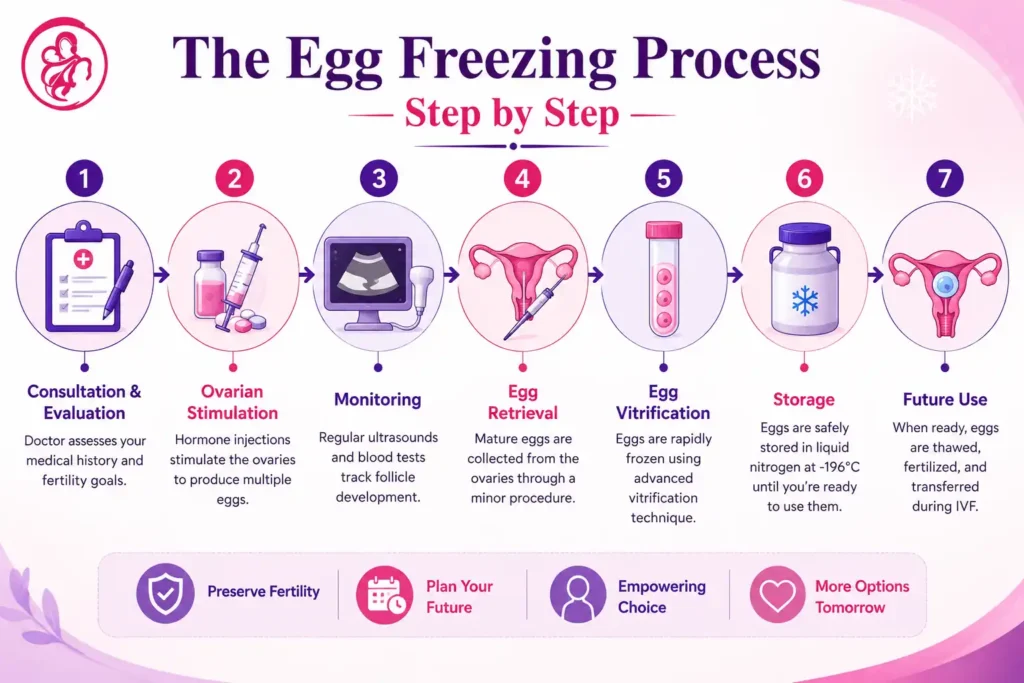
The Egg Freezing Process usually takes around 10 to 14 days from start to finish. During this time, your fertility specialist will be monitoring you closely to ensure that your eggs are developing properly before being collected and frozen.
Step 1: Fertility Assessment
Your doctor will perform blood tests, including the AMH test, and an ultrasound scan to check your ovarian reserve.
Step 2: Ovarian Stimulation
Then you will receive hormone injections for around 8 to 12 days. These medicines help multiple eggs mature instead of the single egg that normally develops during a menstrual cycle.

During this time, your doctor will monitor your follicles with ultrasound scans and blood tests.
Step 3: Egg Retrieval
Once the eggs are mature, they are collected through a minor procedure performed under mild anesthesia.
The egg retrieval procedure usually takes about 20 to 30 minutes.
Step 4: Freezing the Eggs
The mature eggs are frozen using a modern technique called vitrification, which freezes the eggs very quickly and helps reduce ice crystal formation that could damage them.
The frozen eggs are then stored safely in liquid nitrogen until you decide to use them.
What Is the Best Age to Freeze Your Eggs?
Age is one of the biggest factors that affects egg quality and future pregnancy chances.
The younger your eggs are at the time of freezing, the better the chances of a successful pregnancy later.
| Age | Recommendation |
| Below 30 years | Good egg quality, but egg freezing may not be necessary unless medically advised. |
| 30–35 years | Considered one of the best age groups for egg freezing. |
| 35–37 years | Still beneficial, but egg quality starts declining faster. |
| Above 38 years | Lower success rates due to significantly decreased egg quality. |
Of course, age is only one part of the picture. Many women also want to know how successful egg freezing actually is.
Egg Freezing Success Rate — What to Expect
The success of egg freezing is different for every woman because it depends on several important factors:
- Your age when the eggs are frozen.
- The number of mature eggs collected.
- Egg quality.
- Sperm quality.
- The IVF laboratory.
- Overall reproductive health.
Generally, women who freeze their eggs before the age of 35 have better chances of achieving pregnancy later compared to women who freeze eggs at an older age.
It is also important to remember that egg freezing improves future reproductive options, but it cannot guarantee pregnancy.
Choosing an experienced fertility centre with an advanced embryology laboratory plays an important role in achieving better outcomes.
Egg Freezing Cost in Jaipur
The cost of egg freezing in Jaipur is not the same for every woman because each treatment plan is personalized.
The final cost depends on several factors, such as:
- Fertility evaluation tests.
- Hormone stimulation medicines.
- Egg retrieval procedure.
- Laboratory freezing techniques.
- Annual storage charges.
Since every woman’s treatment plan is different, the final cost may also vary.
Is Egg Freezing Safe?
Yes. Egg freezing is considered a safe and well-established fertility preservation method when performed by experienced fertility specialists.
Most women recover within a day or two after egg retrieval.
Some women may experience temporary symptoms such as:
- Mild abdominal discomfort.
- Bloating.
- Light spotting.
- Mild cramping.
Serious complications are uncommon, especially when treatment is carried out under proper medical supervision.
If you decide to use your frozen eggs in the future, the next step involves IVF treatment.
How to Get Pregnant Using Frozen Eggs – The IVF Process
When you decide to start your family you go through the IVF procedure. Your frozen eggs are carefully thawed in the IVF laboratory.
The next steps include:
- The eggs are thawed.
- Each mature egg is fertilized with sperm using IVF or ICSI.
- Healthy embryos are monitored in the laboratory.
- The best embryo is transferred into the uterus.
- A pregnancy test is performed after the recommended waiting period.
A successful pregnancy depends on healthy eggs, good embryo development, and a healthy uterus. All play important roles in achieving pregnancy.
Conclusion
Understanding what is egg freezing can help you make confident decisions about your reproductive future. Whether you want to delay pregnancy because of personal goals, medical treatment, or simply preserve your fertility, egg freezing offers an opportunity to protect your younger eggs for future use.
The right age, proper fertility evaluation, and an experienced fertility team all play an important role in achieving the best possible outcome.
If you are considering egg freezing and want clear answers about the Egg Freezing Process, the fertility experts at Aastha Fertility Care, Jaipur, are here to guide you with ethical advice, advanced technology, and personalized care every step of the way.
FAQ
At what age should I freeze my eggs?
Most fertility specialists recommend freezing eggs between the ages of 30 and 35 for the best balance between egg quality and future family planning. However, the ideal age depends on your individual fertility health.
How many eggs do I need to freeze?
The number varies from woman to woman. Many specialists recommend freezing multiple mature eggs because not every frozen egg will result in a pregnancy. Your doctor can guide you based on your age and ovarian reserve.
How long can frozen eggs be stored?
Frozen eggs can remain stored safely for many years when kept under proper laboratory conditions. They stay preserved until you choose to use them.
Does egg freezing affect future natural fertility?
No. Egg freezing does not reduce your future ability to conceive naturally. Your ovaries continue their normal monthly cycle after the treatment.
Does Aastha Fertility Care in Jaipur offer egg freezing?
Yes. Aastha Fertility Care, Jaipur, offers advanced egg freezing services using modern vitrification technology. The centre also provides complete fertility evaluation, counselling, safe egg retrieval, long-term storage, and personalized treatment planning to help women preserve their fertility with confidence.


Leave a comment